
Conservatives Misunderstand Postmodern Art
to their own detriment

get 45% off an annual subscription!
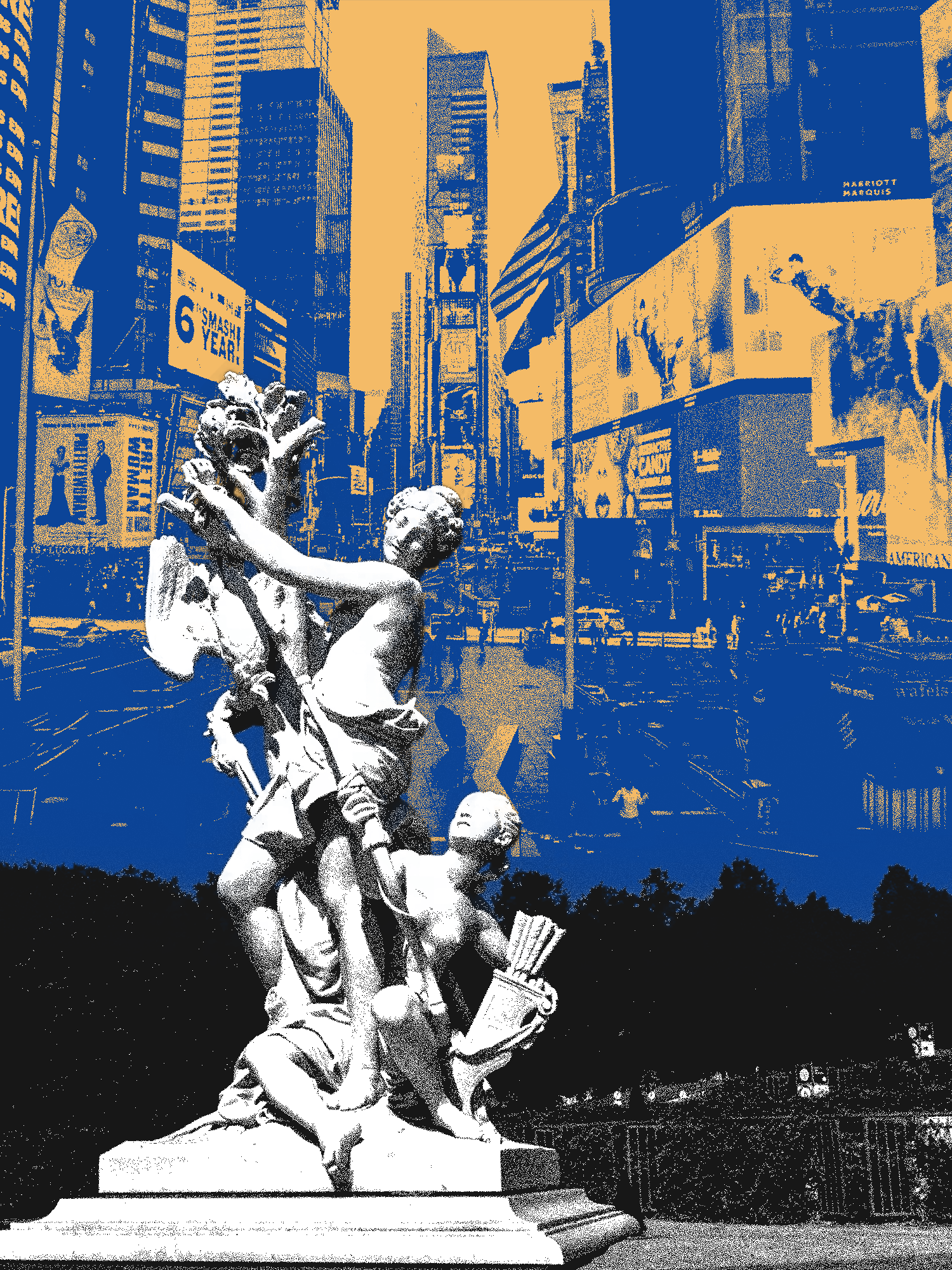
It is often said that one of the most damning indictments of the modern Right is its inability to produce good art. While the tide may be turning, there is still truth to the charge. In the aftermath of the Second World War, modernists, ascendant since the days of Monet and Cezanne scandalizing Parisian salons, with their Impressionist blobs consolidated their hold over the cultural institutions of the West. Classically trained artists and architects were increasingly cast as politically suspect, even authoritarian in a critique reminiscent of one of postmodernism’s belated uncles, Theodor Adorno.
The result was not a counteroffensive, but a retreat. Many small-c conservatives simply withdrew from the artistic mainstream, with noted exceptions such as Salvador Dali, who then and now was derided by critics as “kitsch” for his insistence on painting figuratively.
This withdrawal proved decisive. In the vacuum, modernists breezily marched through the institution’s art schools, museums, and, perhaps most importantly, the built environment a la Gramsci. What emerged was not merely a new aesthetic, but a more novel mode of interpretation ( Cézanne in particular has been credited with ushering in a “new way of seeing”), one that sought to deconstruct inherited forms, particularly those tied to Christianity and its Hellenized understanding of the Logos. . To give a poignant example of this phenomenon, compare Dali’s surreal yet masterful depictions of the Crucifixion with Francis Bacon’s unsettling Slaughterhouse-esque renderings of the Lord’s Passion and see the vicissitude that modernism had wrought to aesthetic imagination.
Yet conservatives have too often misunderstood the nature of this transformation. The instinctive response has been to reject modern and postmodern art outright, dismissing it as decadent, nihilistic, or obscene. While such judgments are not without merit, they are frequently superficial, insofar as grotesquery is often the point rather than a defect. This misreading has a long pedigree. One can trace it back at least to André Breton’s Second Surrealist Manifesto (1930), which urged his compatriots to “laugh like savages in the presence of the French flag” and to “vomit their disgust in the face of every priest.”
The late Roger Scruton, in Fools, Frauds and Firebrands: Thinkers of the New Left, was sharply critical of such figures, yet not merely dismissive. He understood that the desire to “liquidate the bourgeoisie” often stems less from coherent doctrine than from internalized resentment projected onto abstractions such as capitalism. More importantly, he recognized that this artistic revolt was rooted in a deeper despair, one that, once articulated, could be transformed into a program of negation masquerading as liberation.
Like latter-day figures such as Hasan Piker, Breton was able to transmute this negativity into a call for action: to destroy what is, in the hope that something new might emerge following humanity’s victorious gallop into the void.
Much like Francis Fukuyama, conservative art criticism must rid itself of its current defects by ironically embracing a Marxist historiography solely for the purpose of turning it on its head. The sad truth is that conservatives when appraising contemporary works often demonstrate a lack of grounding in the very artistic tradition they seek to repudiate, one whose lineage stretches back nearly two centuries.
Abstraction did not suddenly emerge with the provocations of André Breton and the surrealists. It has deeper roots in the upheavals of the nineteenth century. Consider the work of J. M. W. Turner, whose later paintings dissolve form into light and atmosphere to such a degree that they begin to anticipate abstraction itself. What is often dismissed today as formlessness was, in its inception, an effort to grapple with a world undergoing profound transformation during the Industrial Revolution.
That transformation did not go unnoticed by contemporary observers. Thomas Carlyle, writing amid the dislocations of industrialization, gave voice to the spiritual and social disorientation of modern life, what he saw as the hollowing out of meaning in an increasingly mechanized society. In this light, the trajectory from Romanticism to modern abstraction appears less as a rupture than as a development. It is somewhat ironic that abstraction owes a debt to the very Romantic movement that many conservatives now celebrate, even as they dismiss its artistic descendants with a reflexive scorn more suited to the ilk of X-witter.
What is lacking, then, is not judgment but exposition. To see clearly, one must learn to read modern and postmodern art on its own terms. This requires something like a synthesis between the perceptual revolution associated with Paul Cézanne i.e. ‘Bringing about a new way of seeing’ and the interpretive esotericism of Leo Strauss. In Plain English, conservatives often err by taking such works too literally.
For example, to the untrained eye, the canvases of Jackson Pollock appear as little more than chaotic splatters of paint. At one level, this description is accurate. Pollock abandoned traditional composition, figuration, and perspective in favor of gesture, movement, and process. Yet this is precisely where interpretation begins rather than ends. His work can be read as an attempt to register a new condition of human experience, one shaped by dislocation, technological acceleration, and the psychological aftermath of war. The canvas becomes less a picture of something than a record of action itself, a trace of the artist’s presence in time.
From this perspective, Pollock’s work invites multiple, even competing interpretations. It may be seen as a declaration of emancipation, an effort to break free from inherited constraints and formal hierarchies. It may also be read as an expression of fragmentation and loss, a visual analogue to the anxieties of postwar society. In either case, the meaning is not given in advance. It must be drawn out.
There is, however, a deeper limitation embedded within this mode of expression. Pollock’s art is inseparable from the historical moment that produced it. Its intelligibility depends heavily on the mid-twentieth-century context of its creation. As that context recedes, so too does the immediacy of its meaning. A more substantive critique, therefore, is not that his work is simplistic, but that it struggles to attain the kind of universality that has traditionally defined great art. It is bound to its moment in a way that limits its ability to speak across time. Such a critique, grounded in a defense of the transcendental, is far more serious than the familiar dismissal that “I could make that.”
Ultimately, a more elevated standard of criticism opens the possibility of charting a different path forward that returns to formative principles and muses that have defined the Western Canon for millennia, namely the human body and it’s attendant virtues visualized in its idealized state, for which Kenneth Clarke in The Ideal Nude famously referred to as the “the most interesting subject matter”.
This does not mean returning to the past in a derivative fashion, nor should it be preclude reclaiming the body in the postmodern sense as an object of spectacle, whether in the aspirational sense such as ‘Looksmaxxing’ or transgressively in a fashion akin to the French conceptual artist Orlan’s oeuvre, which exemplified how even the body can be reduced to an instrument for manipulation or display in a commodified society. What is required instead is a recovery of a more demanding vision, one that treats the human form not as a medium for experimentation, but as a good in itself.
Such a recovery entails a renewed commitment to excellence in form, pursued not for irony or subversion, but because it is intrinsically worthwhile. The traditions of the Beaux Arts and the Old Masters have not simply faded. They have been actively set aside. Yet this rupture also creates an opening. If continuity has been lost, it can be restored through deliberate effort.
For conservatives seeking to rebuild rather than merely critique, this moment presents a paradoxical freedom. One can begin again in the manner of the ancients, not by rejecting history, but by rediscovering first principles. The starting point is the human person as the measure of form and meaning. The task begins with the cultivation of the body itself, the pursuit of proportion, strength, and harmony, and extends outward into artistic representation that seeks to elevate rather than deconstruct.
The goal is not to outmaneuver the avant-garde on its own terms, nor to produce a hollow imitation of past styles. It is to recover standards. In an age defined by distraction and ephemerality, this requires a reordering of priorities, a renewed attention to the arts as a measure of civilizational seriousness. In essence, less Polymarket, more Polykleitos.
 | A guest post by
|
Is there really any good contemporary art coming from anywhere, left or right, though?