

Get 50% off an annual subscription!
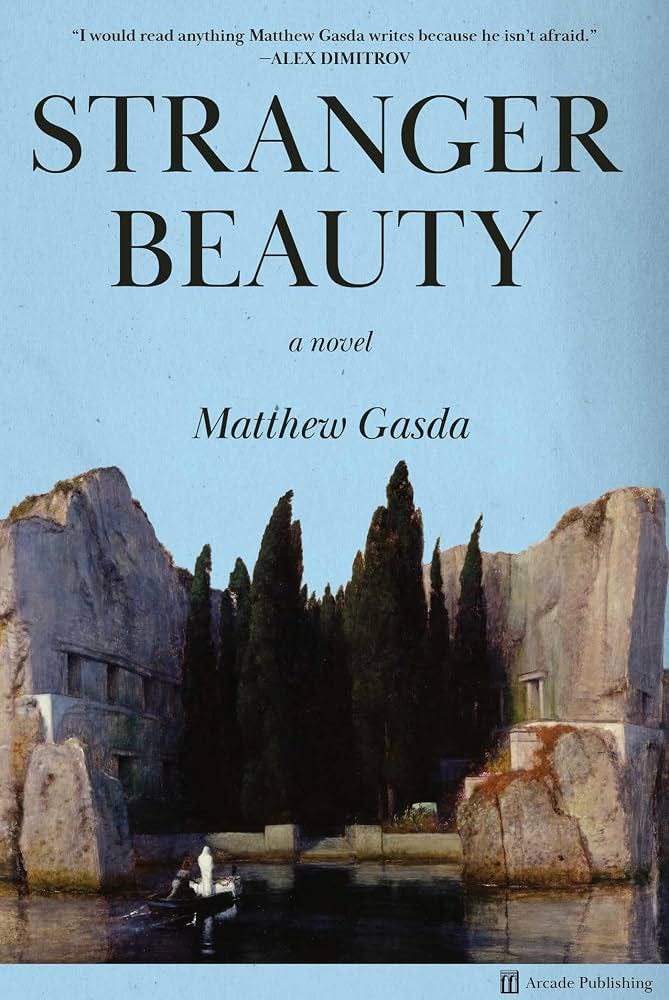
Being a writer in the same generation as Matthew Gasda is an awful thing. Consider how few writers in their thirties can compete with his cultural footprint: a dozen well-received plays and novels, two poetry collections, a bohemian life in New York City running a theatre company while also co-founding and editing a literary journal dedicated to Romanticism, plus publishing a popular Substack newsletter and writing essays for multiple magazines. Add onto this his formidable talent, and it’s easy to understand why I have twice subscribed and unsubscribed to his ‘Writer’s Diary’ of epigrammatic fragments. It’s no fun to be seething with envy every time you open your emails, knowing that there is a man of your generation who is living a lifestyle you believed was gone for good, and having insightful thoughts about it to boot.
Envy is not a state I wish to remain in, and when I take a deep breath, I do not actually begrudge Gasda his success, given how seriously he takes his craft. If anyone is to take on the mantle of being our generation’s bohemian romantic, I’d rather it be one of the few writers who is capable of grappling with the tension between tradition and modernity, between mysticism and technology, between morals and aesthetics.
And so I’ve resubscribed to his ‘Writer’s Diary’ and have been reading through past entries which are filled with fragments which challenge and inspire and occasionally provoke me. This mode of writing, of arranging a series of short philosophical sentences distilled down to purest observation and truth, is something Gasda excels at. And this mode forms the backbone of his latest novel Stranger Beauty, in which Gasda projects himself into the depressing future of NYC in 2038.
In this realistic futureworld, AI is fully incorporated into households via agents named ‘Kairos,’ all cars are driverless, food is lab-grown and delivered by drones, many people’s brains are chipped in order to be hyperintelligent, and there are pills which help you live longer via nanobots rejuvenating your body and keeping you artificially young.
Despite its futurism, there’s a timelessness to the way Gasda writes, a timelessness in his settings and characters and preoccupations. Much of Stranger Beauty could easily be set in 1938, aside from a few stray anachronisms. It made me wonder if there are really any new questions to grapple with in the age of artificial intelligence. We are still left with the problems of faith, of how to love others, of the futility of glory, of the value of our legacies.
In Gasda’s imagined future, M has a complicated marriage with an actress, S, a complicated relationship with his institutionalized brother, Christopher, and an uncomplicated relationship with his seven-year-old daughter, Ruby. The novel is immediately immersive in terms of giving you the sense of a dystopian future, and M is well-textured as a character, even if he is an obvious projection of the author. The scenes we get in 2038—Ruby playing the piano while M reads and ruminates, a winter walk and conversation between M and S about their strained marriage, a confrontation about faith and pride between M and Christopher at the facility Christopher permanently resides at—demonstrate Gasda’s playwright instincts of dialogue and blocking. We can hear the characters and their sparking conversations, we can imagine them on stage together. Whether we can believe they exist in a wider world filled with other men and women is another question, as the novel is extremely narrow in its focus on M and how he thinks and feels.
A huge portion of Stranger Beauty is given over to fragments from diaries written by ‘M’, Gasda’s stand-in and the protagonist, before the widespread use of artificial intelligence. M has kept these diaries and a screenplay locked away from Kairos’ prying eyes, determined that they remain pure and unsullied by the cannibalizing instincts of LLMs. The focality of this plot point, and the way M’s wishes are ultimately betrayed, makes one wonder if someone in Gasda’s life has ever uploaded his writing to an LLM without his permission, and whether this would be a sin he couldn’t easily forgive.
If you like Gasda’s Substack, then you will enjoy the fragmented diary portions of Stranger Beauty sprinkled throughout, for as M writes, “The addiction to the fragment is an addiction to the barest and truest parts of speech, the earliest hope of speech, which knows that its dissipation will come through context, explication, iteration.” The magic trick Gasda manages to pull off again and again is the distillation of truth or paradox into a few words. In our age of over-explanation and noise for the sake of noise, this is a welcome countermeasure, and it does work as a method of immersing us into M’s character.
Gasda is working here in the tradition of Novalis, that German mystic philosopher poet who inspired much of the late 16th Century’s experiments in Early Romanticism. Novalis viewed the fragment as more ‘alive’ than a ‘dead’ book of completed and complex arguments, stating in his seminal work Pollen, “Fragments of this kind are literary seeds.” To Novalis, a fragment was like a poem, more alive because it required the reader’s own imagination to grow and complete it.
Gasda is a master of the form, and like Novalis, he fluctuates from cutting observations on the mundane realities of life, to commenting on modern politics and economics, to deeper questions of faith and reason. Some of my favorite fragments from Stranger Beauty’s fictionalized diary entries include:
“A single good day on earth is good enough. It’s as good as eternity. I think from the premise ‘I don’t want to die,’ we can’t draw the conclusion ‘I should want to live forever’.”
“I am mangled by the digital machinery that I both use and am used by.”
“Some part of me never really accepted that the world outside would not love me as much as the house I grew up in…”
Gasda’s theory seems to be that fragmentary writing, as opposed to over-explained AI sycophancy, forces even those readers with severely damaged attention spans to stop and puzzle out what he’s saying. His fragments are often blunt statements, with little room for nuance. But forcing the reader to consider each fragment is exactly what Gasda is trying to achieve: to arrest us from our smooth glide through a frictionless world, to halt us in our seemingly inevitable downward spiral toward a dystopian future.
Gasda is particularly interested in Catholicism as an inescapable inheritance, as something genetic and unshakeable, and yet terrifying and overwhelming. That’s why certain sections of this book reminded me most of Cormac McCarthy’s recent novel Stella Maris, down to the sense of watching a two-person play unfold within an asylum. But Gasda is less elliptical than McCarthy, much more quotable, which is why I often found myself highlighting many of Gasda’s pithy epigrams on aspects of faith and family:
“If I’m a sinner, then I have hope: I can be redeemed. If I’m merely bad, then I’m hopeless: pathological.”
“On one hand there’s the body, which is an engine running down. And then on the other hand, there’s the living world, which is unfolding toward increasing order and complexity. We are dying in other worlds, and the world is living and living and living and living. We’re islands of disorder in a sea of order.”
“The summit of sexual fulfilment is a home with children, like a flare in the distance. But I choose to remain at the base of Mount Purgatory while others climb toward the light; to go forever in a carnival mood and a mood of reproach. Tired of my own lust and overstimulation.”
“All I want is children, a child. I’m afraid to say it. The unconditional love one gives and receives from a child. That all-healing love. This is part of just preparing to get married and looking ahead in a new way; not looking back toward youth anymore or not clinging to it, not quite the same way I used to.”
The particular focus on children and fatherhood are beautiful in the diary fragments, but also reveal the weaker elements of Stranger Beauty’s more plot-based scenes. While the characters of M and Christopher are finely drawn portraits, almost twin brothers who act as mirrors, the character of Ruby (M and S’s daughter) felt thinly sketched; a caricature of a child with M as a caricature of a father. M doesn’t seem to have any strong sense of identity invested in Ruby, despite his purported desires to be a father. He isn’t portrayed as having that heart-tugging investment in the little girl who is bone of his bone, flesh of his flesh.
If I hadn’t recently had a son I may not have noticed this, but fatherhood really is a foreign country and it’s hard to truly project yourself there, to that place where you willfully subordinate yourself to the life of your son or daughter. Although Gasda is a talented writer, it is somewhat limiting that he feels most comfortable writing as M, a futuristic version of himself, rather than attempting to write fragmented diaries in the voice of someone totally different. Even the character of S becomes less interesting in the later portions of the book when she is no longer directly interacting with M. In his absence, she is rendered an inert and cardboard version of herself.
The ending of the novel will be challenging to many readers, a stream-of-consciousness experiment with AI-styled writing that discombobulates and blurs the plot first into an imagined film and then into a word salad, quite unlike the obsequies and chatty LLMs we know today. This final portion is most reminiscent of Ayad Akhtar’s 2024 play McNeal, in which the main character, portrayed by Robert Downey Jr., descends into a drug and alcohol induced spiral, increasingly dependent on AI to write a book regurgitating his and his deceased wife’s writing while passing it off as his own, and then ultimately giving the audience an LLM-generated speech to close out the show.
Gasda seems to be purposefully inverting this dynamic. Instead of the fraudulent genius relying on AI to do his work for him, Gasda’s M distrusts the machine so completely that only another can subject his work to its algorithm, and the reader is left trying to puzzle out the ethical and aesthetic ramifications of this decision and its result. Personally, I was left convinced that nothing was gained and much lost by the sacrifice of M’s writings to the false god of Kairos.
Gasda may be our greatest young writer working today, and certainly one with the keenest aesthetic sense of what the 21st Century is and might be and ought not to be. Stranger Beauty manages to capture an element of that in a short and constrained book, shedding light on the possible futures immediately before us and laying choices at each of our feet. Or maybe I’m wrong to say that the novel sheds light; perhaps it’s better to say it captures it—light which is mostly generated by Gasda’s keen insight but also generated by the reader, in the act of reading and teasing out his or her reaction to the book and its fragments. As one of M’s diary entries reads:
“Art does not illuminate, it is illuminated, the way a cathedral receives light. A work of art is a cathedral. A structure that can be inhabited.”
Stranger Beauty cements Gasda as an aesthetic auteur, spearheading a generation of writers who are invested in slicing open the ailing body of postmodernity and looking at its many cancerous tumors directly. That Gasda manages to do this kind of surgery delicately, inviting the reader to dance through diaries and fragments and small scenes of domestic discomfort, as well as through screenplays and AI conversations, is no small feat. And it makes me look very much forward to future novels from Gasda where he puts his formidable talents to work painting a larger and more varied landscape.

Did you enjoy The Sleepers or his fragmentary pontifications of pseudo-intellectual hot air excreted through diaristic halitosis?