
I <3 Jesuits
the Ignatian charism is the most powerful in the world

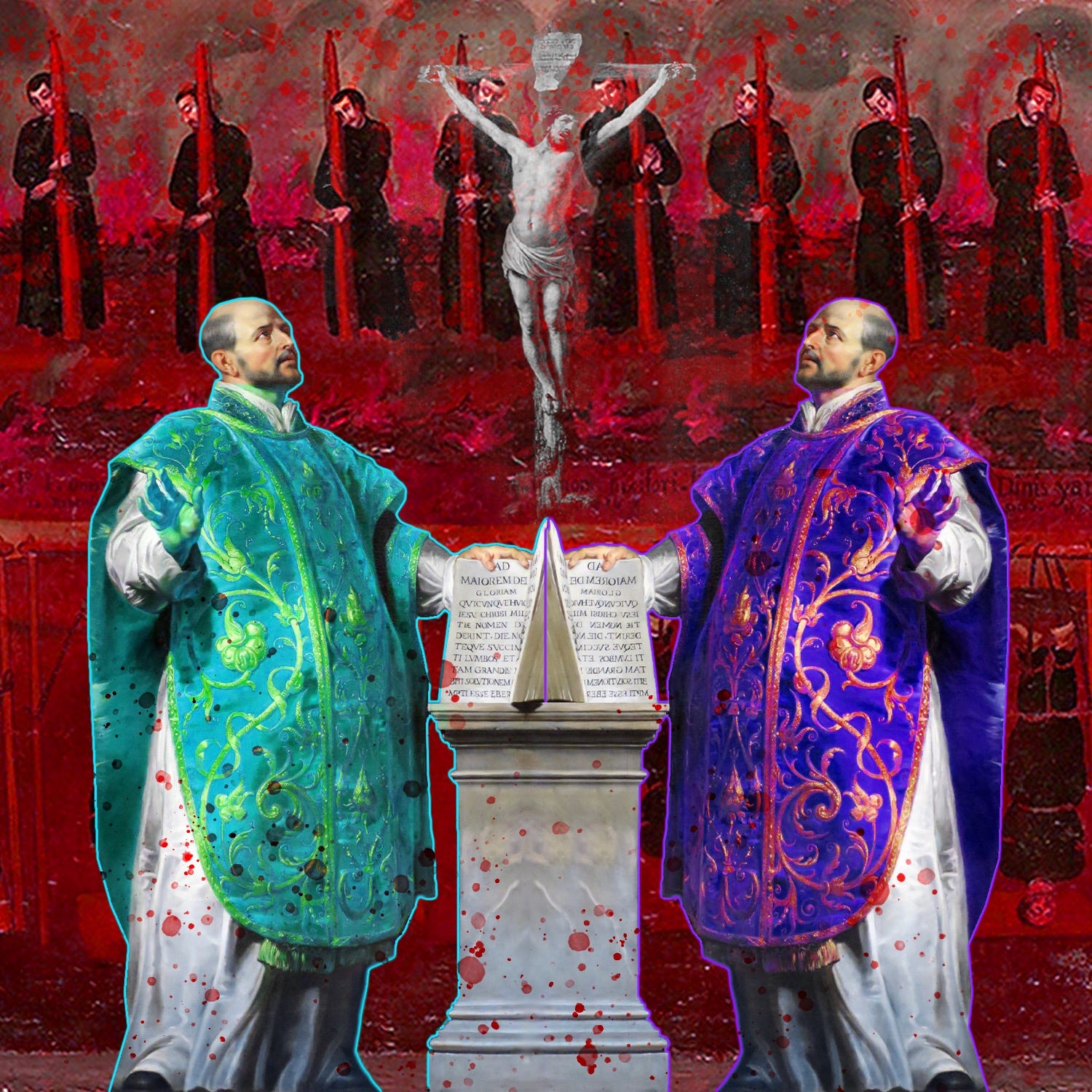
As you should already know by now, cracks in pomo has gone out of its way to promote based Jesuits. And top of having published content by and interviewed several Jesuits, numerous young based Jesuits have expressed to us how cracks in pomo has given them hope—as we are a refreshing alternative to both the cringe ones they have to deal with on a daily basis in their own Society and their obnoxious trad peers who prioritize ideology over Jesus.
It has become commonplace in conservative Catholic circles to mock Jesuits for being “liberal” or “heretical.” Sometimes, this is (sadly) the case. For too long, Jesuits who are very out-of-touch have been giving the Society a bad name. I encountered these kinds of Jesuits at Fordham. But thankfully, the young ones are swinging the pendulum back to the middle, and are prioritizing Jesus and their mission over all other (cringe) things.
In honor of the feast of St. Ignatius, I thought I’d flesh out why I value the Society/Ignatian charism so much on a personal level.
Finding God at/in spite of Fordham
My relationship with the Society began at Fordham. I had no intention to attend Fordy. I think I only applied because my advisor suggested that I do it. When I showed my Spanish teacher (who was writing my recommendation) the list of schools I was applying to, she said, “you’re going to Fordham.” And I was like, “yeah definitely not.” “No,” she said. “You’re going there, I just feel it.” My plan was to go to a school nearby in NJ so I could live at home. Said school gave me a huge scholarship, and Fordham gave me a very tiny one. Even more of a reason to stick to my plan.
But after I got an accepted students day invitation in the mail, my mom suggested I go just to see it. During the visit, something caught me. I don’t know what it was, but I felt that I was meant to go there. That meant foregoing the bigger scholarship and having to live in the dorms. Despite not being very religious at that point in my life, I decided to pray on it, asking God to give me a sign. Soon after, something in me said, “just go to Fordham.” So I obeyed.
At Fordham, I had several encounters that radically changed my life. The first two were in my required Intro to Philosophy and Intro to Theology (Faith & Critical Reason) classes. Those two professors were the first people who ever took my existential questions seriously (most other adults would just dismiss them and tell me to focus on “real” issues). Then I met a Jesuit who became my spiritual director of sorts. Then I met a classmate who invited me to a lay movement in which I’m now “heavily” involved (ie sold my soul to).
On top of these encounters, I was deeply formed by the intensive core curriculum which aimed to cultivate a comprehensive understanding of life and the world, as well as by the focus on social issues and accompanying/serving the poor. I had the opportunity to engage in several charitable works and go on mission trips while I was there.
Yes, a lot of the classes, professors, and programming were cringe (and sometimes straight up heretical). Campus Ministry hosted dumb stuff like discussion groups for people who were “spiritual but not religious,” Ignatian yoga in the chapel, and Qatholic Mass (Q stands for Queer). Few of the theology professors actually believed in the Magisterium. There was lots of virtue signaling about flavor-of-the-month social justice issues and sycophantism over Foucault and Butler. And basically everyone—including several Jesuits—was gay (which caused serious issues for friends of ours like poor Sebby).
But in the broader scheme of things, my Jesuit education enabled Jesus to find me…and really has shaped my spiritual and professional lives (which is why it’s such a shame that on top being being so fake and gue, Fordham is becoming increasingly globohomofied, as I wrote in Compact).
The Ignatian charism saved my soul
Over time, I’ve come to deeply value the Ignatian emphasis on conscience and discernment. It’s helped me to understand what true obedience to God, the Church’s teaching authority, and more immediate authority figures really means—that in order for it to be true, it must engage all of my freedom, reason, affectivity, and humanity.
Further, it’s helped me to see that Jesus respects my freedom, and is patient with my weak flesh—which is to say that he doesn’t demand perfect, immediate adherence to every moral ideal. This is also why I think Pope Francis’ attempt to accompany people in irregular circumstances (like divorced-and-remarried people and gays in unchaste partnerships) was important, as much as they were executed in a rather sloppy, imprudent manner.
Yes, some Jesuits over do all of this. Too many of them arrive at the conclusion that conscience can operate without remaining in tension/dialogue with any form of objective authority…or that the law of gradualism means that you’re in a state of grace when actually you’re still in a state of mortal sin. I think that many of these Jesuits are trying to compensate for the moralism that many of them faced growing up (especially if they are Irish!!!).
I also think that the deeply American spirit of entitlement and “fairness” has caused them to lose sight of the category of the Bad Catholic (that you can still be “accepted” in the Church even though you don’t follow all the rules…you just have to abstain from receiving communion…and can’t demand that we change the rules to make you feel better about yourself). The American Protestant either/or mentality—which has propelled the impulse to “normalize” everything, including sin—has clouded Jesuits’ ability to embrace the great Catholic both/and.
Anyway, I found this emphasis on conscience and discernment overlapped with aspects of charismatic Christianity and the charism of Luigi Giussani1—both of which played a major role in my spiritual path. While Jesuit “open-mindedness” and emphasis on subjectivity can be misinterpreted as a kind of relativism, when done right, it is lived as an openness to God’s creativity, to how he may choose to surprise us in ways that transcend human logic. While it’s a mistake to say that “the rules” and doctrines are unnecessary, Jesuits are right to place an emphasis on our subjective experience, because it is there that I discover God’s initiative in my life—which saves me more than any of my attempts to follow all of the rules.
When done right, the Ignatian emphasis on conscience and discernment can do wonders for your relationship with Jesus. Many thanks to a particular Jesuit who helped me use these principles during a very crucial crossroad in my life.
What pomo & Jesuits have in common
This desire to remain open to how God might surprise us in “irregular” circumstances that—on paper—are “against” him (or his rules) is ultimately what unites cracks in pomo and the Jesuits. Our agenda of looking for Truth in the cracks of postmodern culture—in Lady Gaga’s music, Baudrillard’s critical theory, the dirty skreetz of NYC—is in fact quite Jesuit-coded. We strongly believe that if you go to the depth of something that is conventionally considered “bad,” God might surprise you there.
Of course Gaga is against God. Most good Christian’s should not listen to her. But someone has to be willing to go to the depths of the abyss of postmodern culture and find God there…to try to find grace slipping through Gaga’s narcissistic attempt to garner more applause from the public. This is cracks in Pomo’s job. The Jesuits have a similar job—which is why I don’t get totally enraged (well, maybe a little) when I see them doing cringe things like rainbow Masses. Sure, that example goes a lil too far, but the Jesuits aren’t wrong to look for the glimmers of good hiding in “irregular circumstances.”
Again, someone’s [but NOT all of us] gotta do it. The same way I told Nick Leeper SJ to stop being such a Jesuit when he said Andres Serano’s Piss Christ might not be sacrilegious, we need the Jesuits to be “such a Jesuit”…just like we need cracks in pomo to be so edgy and controversial. Someone’s gotta be willing to piss people off by challenging them to call into question what they take for granted to be true. [This goes back to my quasi-Hegelian thesis about how we all have different pieces of the puzzle.]
In a similar vein, I respect how the Jezzies’ openness to “the world” inspires many of them to work their ways into high places. The only person who seems to recognize the value of this is Rusty Reno, who wrote about it in his post-mortem on Pope Francis. This is another reason I still have respect for the cringe Jesuits who espouse whatever elitist social justice position du jour.
Throughout history, the Jesuits have recognized the need for members of the Church to be present among those with the most influence and power in the world. This is why they often will “play the game,” saying and doing all the things that the elites do…in order to gain credibility and access into elite circles.2
Cracks in pomo uses a somewhat similar method of subversion from within.
Jesuits are ballzier than [most of] you
And lastly, and most importantly, I know many missionary Jesuits who risk their lives to bring the Gospel to those who are actually on the margins of society…for whom social justice is much more than virtue signaling about bourgeois-people problems. These Jesuits are anything but cringe…they are more based, virile, and holy than I [or you trads] will ever be.
The charism of St. Ignatius is one of the greatest and most powerful in the Church. Thus, when Jesuits get things wrong, they always get it really wrong. But when they get it right, there is nothing greater than that! This is why you can’t just dismiss them as “heretics” and call it a day. It’s too easy! The impulse that leads them to extreme heresy is the same one that leads them to extreme sanctity. [It’s the same with the gays!]3
Also shout out to America Magazine…I may not agree with every single thing they publish. But they have some of the greatest editors I’ve ever worked with…and some of the greatest people I’ve ever met.
The charismatic emphasis on discerning the spirits, Giussani on experience and one’s “I”, engaging the “totality of factors” in the real, looking for “signs” in reality and making a “judgment,” the emphasis against “moralism” and “formalism” and in favor of education and culture.
Some insist that they aren’t actually subverting elite circles for Christ from within, and that instead they are trying to subvert the Church from within (see the many conspiracy theories about Masonic Jesuits). But at the end of the day, someone has to make their way into elite circles in order to witness to Jesus…and you gotta play along in order to do so. That’s why I pray for them to learn to draw the line between being “in” the [elite] world and not “of” it.
That being said, this is why I’ve argued that the pro-gay Jesuits are more akin to homofascists than to the “libt*rded” rainbow lobby. There is an aristocratic edge to Jesuit homophilia…and of course, what’s going on in their seminaries is much more reminiscent of the Ancient Greek archetype of homosexuality than it is of your standard bourgeois gay identitarian “love is love” archetype [yes, I said it].