
In Progress & Regress
on AJ Fezza & Matthew Gaetano’s 'Rearview'
We asked one of our favorite book/film reviewers (Jonah) to review on of our favorite writers’ (AJ) recent short film, which you can watch here.
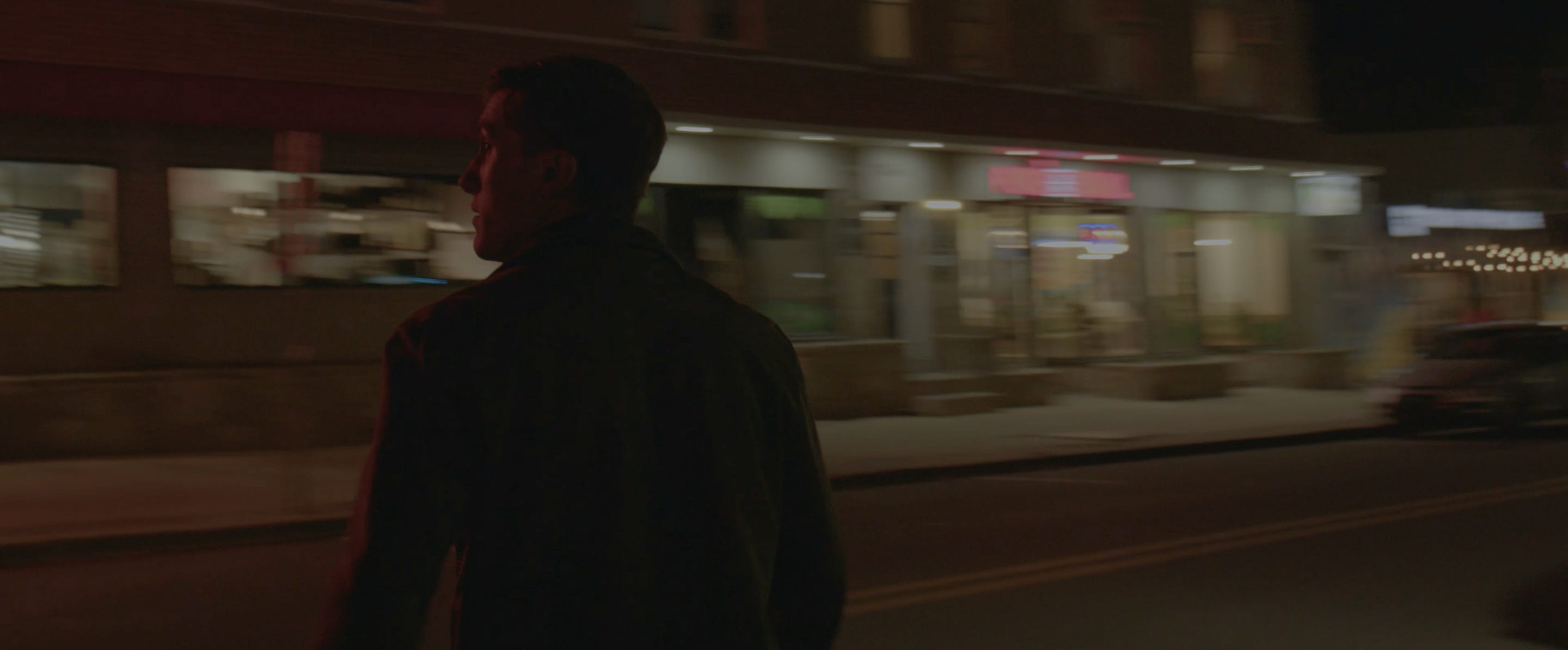
Rearview starts at night, inside the dark car of Ian (Sebastian Pestritto), an Uber driver somewhere near Philadelphia who, enraged at a passenger who insists on smoking in the car, pulls over, drags the guy out, pummels him, then gets beaten down by the guy’s friend. They steal his car (with his phone inside) leaving him with a black eye and a cigarette burn on his arm on the grassy median of some highway.
That’s scene one. This far in, I was engrossed—What’s Ian, the driver, gonna do now? Can he get his car back? He can’t call the cops; he’ll be jailed for assault. He started it. So who is he? Where’s he gonna go, and who does he know who can help him? Can he reach that place, those people, without a phone? When will he meet those two guys again? The cigarette burn on his arm is an appointment—he has to find and confront them, right? But what really is justice, here? And why was Ian so furious in the first place? Why was his mom calling him so late, and why did he dismiss the call so aggressively, pawing at his phone like a boxer hitting a speedbag?
The film abandons all those questions at this very moment, so it feels like it started with a good, sharp idea—then just pivoted. Or it followed a less obvious plot, and my being used to genre conventions of thriller and adventure flicks caused me to see that as an abandonment of its opening conflict. Eventually (as you’ll see), I go with the latter interpretation.
And then, too, after this first scene, I was also engrossed because it rang a real old bell for me. I worked a while in college as a taxi driver. Didn’t stick around long, but left with a huge admiration for those who can. I wasn’t with Uber or Lyft, but a local company based in a garage right off campus. No company name blazoned along the roof, just a multicolored metal dragon hung above the tin mailbox by the door. They never saw my license or knew my last name: I did one ride-along with a longtime driver named Elijah, then the owner asked if I could work a night shift and if I was good at texting and driving, and I was hired: I’d pay them a $60/night leasing fee for the car and keep whatever else I made.
We mostly shuttled regulars: We had informal partnerships with the area’s halfway houses, so when somebody’d just left jail and didn’t have a car or a valid license, we’d bring them to and from work. Generally just a few miles, a twelve- or fifteen-buck ride each way. Bars would call us to pick up trashed customers. Some of the local drug pushers would take our cars to and from deals and drops, since we didn’t track rides or keep address data like rideshare apps. Our cars, mostly ‘90s Cadillacs, weren’t computerized. The company’s number one rule, as the owner told me my first day, was “Get ‘em from A to B, and don’t ask why.” Once it got late enough, I’d park outside college bars and shout, “Local taxis don’t do surge prices!” I knew the usual closing times of every bar in town. That kind of thing made me most of my money, unless I caught a rare night full of airport runs.
One night, our dispatcher sent me out to a remote apartment block nestled down in a hillside. This was around three AM; my shift ran from dusk seven to dawn seven. The woman who climbed in my passenger seat—up in the front; no official notices and plastic-plate glass like a city cab—was roaring-sad drunk, reeking of liquor and vomit, sweaty hair plastered down on her head. When I got to her house, she asked if I’d walk her to the door. She did her best to flutter her eyelashes. What she wanted was obvious. I told her no. I had another ride to get to. Then she offered me an extra $50 if I’d come in with her. No. Then it was $75. She started crying. She’d cracked the door but hadn’t really opened it. In the end, I had to circle around the car—careful to take the keys with me—and pull her out, lead her down the driveway, peel her hands off my arm, and wave goodbye outside the door.
She called dispatch and asked for me specially the next three nights, each time with the same reluctance to get out of the car, the same bargaining offers if I’d come in with her. After the third night, when I got back to the office, everybody was standing around one of the cars, smoking. They were all smiling when I came in.
“So…you done it yet?” Elijah asked.
“No.”
“She peed on you yet? When you’re trying to get her out of the car?” Another asked.
“No.”
I never got a call to pick her up again, not in the—I don’t know, weeks or month that I worked there. There were other memorables: The man I drove home from his 60th birthday party, wasted as sin itself, who spent the half-hour ride telling me how he longed to die of a heart attack hipbones-deep in a hooker. There was the couple who thought their friend had gone missing, maybe even been murdered and dumped—they were sobbing, screaming, rapid-cycling in the back seat for an hour while I drove them around town to every friend’s house and dark alleyway—only for me to bring them back to their apartment to find she was asleep on their couch, and they’d just been too drunk to notice her before. That was, for them, a $145 fare. I’d missed two rides in the meantime and was on thin ice with dispatch. I drove ‘til nine AM that day to atone.
When I got home from one of those twelve-hour shifts, I was exhausted physically, mentally, and spiritually, seeing in moving tesseracts as though I was always zooming at fifty miles an hour down some road. Until I went back to drive again, I felt mean and agitated. I was angry at the wind and everything else. I slept as best I could; every hour of waking sunlight felt stolen, like I was some kind of fugitive. More than once, friends gently asked me, “You ever seen that movie, Taxi Driver?”
I hadn’t. But when they (invariably) described it, I thought it sounded super unrealistic. He wouldn’t attack some politician. His thoughts wouldn’t have that kind of scale or continuity. He’d strike, not where it hurt (the system, the regime, whatever), but where he hurt; he’d take out his worst passenger on his worst day.
That feeling, and that realization, first hooked me on Rearview. And it does deliver on what that feeling promised, if (thank goodness) not in the way I originally expected. In any case, the future looks promising for its makers.
1: Close-up
If I were giving an elevator pitch for this short to a potential producer/investor, treating it as a proof-of-concept to look for support on a feature-length version or a series, I’d say: “It’s like American Psycho if its protagonist was on the bottom, not the top, of the economic ladder, and if the film was edited by the guys that did Spring Breakers.”
That pitch-synopsis points, first, to just after the film’s three-minute mark: Ian is applying an extremely detailed (for a dude in his 20s) skincare regimen: A mask, lotions, various tonics. And this is cut together in tight, almost twitchy montage with shots of him lifting weights and punching heavy bags in an empty boxing gym: Either he’s the most dedicated or the most anxious or unliked of the gym’s members.
The film never says which, but it hints at all three. In any case, the references to American Psycho and Taxi Driver are clear—and maybe even to We Need to Talk about Kevin, the school-shooter movie. Ian gives oodles of such vibes, and at one point he fantasizes gunning down a random woman’s tiny dog outside a stripmall.
But unlike those films, Rearview does not, in the end, offer Ian anything to have been training for—just a pile of regrets and misfires and one glimmer of misleading hope, nestled snugly into a flashback.
Gaetano (as cinematographer) and Fezza (as editor) mostly nail the lighting and color, and when we see Ian loping off with a newly punch-purpled eye along the road, first trying to hitch a ride to a party he wanted to attend in Philadelphia, then asking random people on the street to let him use their phones, there is some serious suspense building.
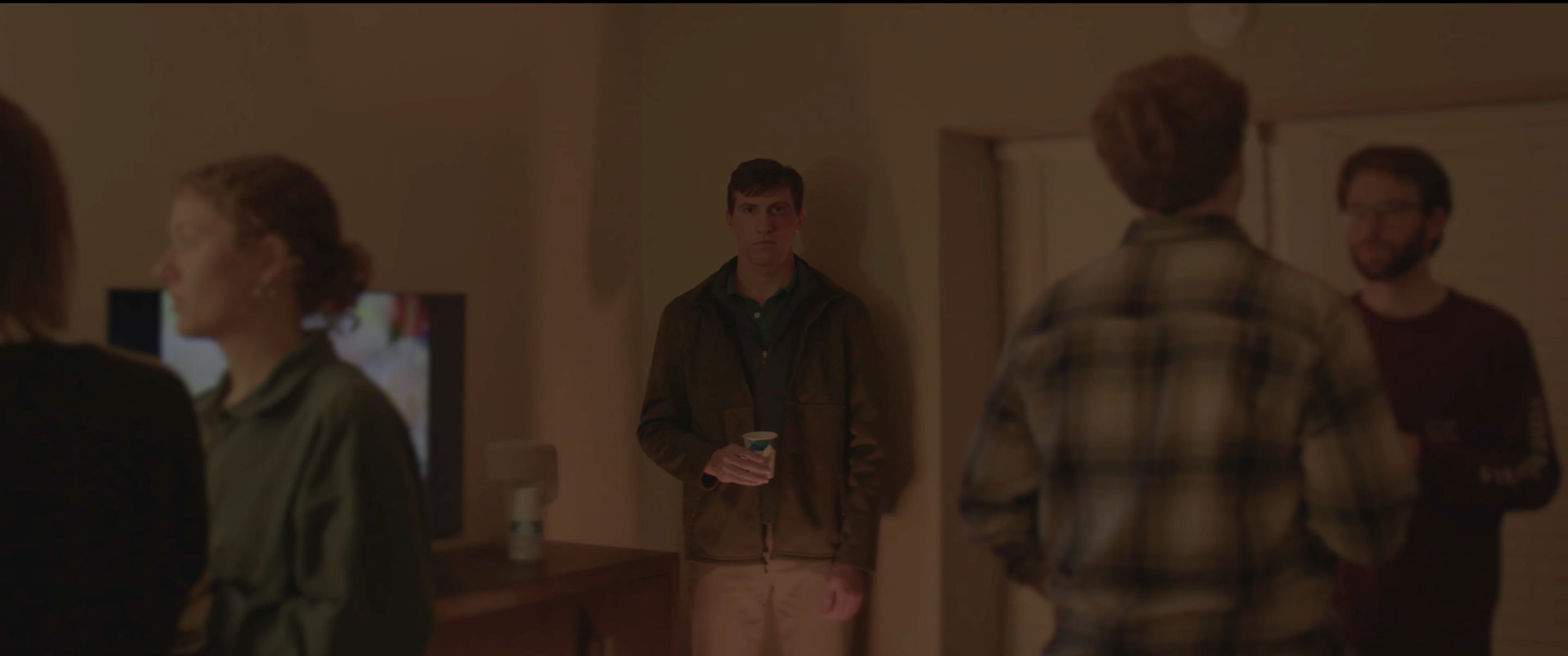
From then, the film shifts focus to Ian’s odyssey to that party and his libidinal investment in it: In flashbacks, we learn that he and his girlfriend, Olivia (Zoë Grimm), had broken up a short while ago. He liked her a lot; he thinks about her incessantly. Seemingly they separated because he was so irritably insecure about not being able to defend her when someone stole her purse; thus, supposedly, his post-breakup obsessions with lifting and boxing. A bit after the breakup, when Ian’s old friend Noah (Thomas Sarrouf) came to town, Ian accompanied him to a party and had a one-night hookup with the beautiful stranger Cecilia (Gia Caruso). In his memory, Cecilia’s face maps onto and occludes Olivia’s.
The party he’s going to tonight, after the two unnamed frat guys beat him up and steal his car, is at the same apartment, and he is desperately hopeful he’ll see Cecilia there again. But Ian’s attempted seduction speech, when he finally reaches that Philly party, and it’s almost emptied out, and he approaches Mary (Grace Collins) and repeats exactly what he’d said to Cecilia at the flashback-party—that repetition is extremely effective in showing the basic fear and fragility of Ian’s character—which, retroactively, does something to explain his obsessive skincare, his lifting and boxing workouts in that early Bateman-esque montage, as symptoms of a thing that runs deeper than just post-breakup insecurity.
2: Zoom-out
AJ Fezza and Matthew Gaetano named their filmmaking endeavor, 308 Studios, after the number of the dorm room they shared at Villanova. Fezza’s earlier Fermata (2023) won the Audience Choice Award and Best Editing at Villanova’s own film festival, the Villys. Gaetano’s first publicly findable film with Fezza, also the first 308 Studios release, Milk Noir (is that a slant-joke pun on film noir and the first words of Paul Celan’s “Todesfuge”?), came out in 2024.
As I said before, there’s a beautiful quest implied by Rearview’s first scene. As a teaser to a wanton, fast paced adventure that could’ve turned out something like After Hours, that first scene is fabulous.
What Fezza and Gaetano provide later, however, implies that what they really want to center is Ian’s total aloneness, and so that first scene points to a different resolution entirely.
All social interactions—with his passengers, with Noah, with Olivia, Cecilia, Mary—are totally baffling to Ian. He either assumes too much from what little he can read on people’s faces or in their behavior, or he totally misses every cue there is. So far, so much like Jordan Castro’s protagonist Harold in Muscle Man; I’m reminded, especially, of his neurotic overanalysis of run-ins with his colleagues before and during the book’s opening faculty meeting, and of his fixation on bodybuilding as compensatory refuge. As gym-bros have said since before the first plate-loaded barbell was conceived, “Women come and go, but the iron never lies.” There’s some self-reliant wisdom in that, and there’s some fragile distrust that’s way older than any “crisis of masculinity” discourse.
But Ian’s own crisis totally breaks (only to reform) when he hooks up with Cecilia in his flashback: There, he’s just as socially myopic as ever, but she quite clearly doesn’t care. She just thinks he’s cute, full-stop. And that memory, that moment of feeling less alien, or of being wanted despite or even for his alienness, haunts him at least as much as what the film presents as the more explicitly painful memory, that of the night he couldn’t stop the man who robbed his ex.
So, as I think on it more, Ian’s regimented exercising and skincare, his ambient irritability and spacey distance, aren’t just hurt reactions to his memory of martial impotence. He’s seen, with Cecilia, that his appearance can simply eclipse any expectation that he be charming or socially astute.
He is alone, not in the sense that he is without people in his life—he has friends, had a girlfriend, whatever—but in the sense that he has given himself a subtle but seemingly irrevocable vote of no confidence in his ability to relate emotionally and then verbally to other people in a way that they find relatable and agreeable, and that he finds true.
And here, as he tries and miserably fails to flirt with Mary at the film’s end, and his image fractures as he stares confoundedly out into the stale party’s air…maybe this is, after all, the return of that first scene, of his driving.
Driving a car for long enough hours to make a living, it erects an invisible wall at the back of the front seats. The folks in the back might be friendly, might be total assholes, but eventually all but the most unique of them blur together—especially when, nine times at least in ten, they don’t say a word to you at all from pick-up to drop-off. The feeling you walk out with, after a long day or night, after you’ve used the rental vac at the gas station to mini-detail the car, is of a total split: There is the socially interconnected and continuous world of passengers, and there is the distant and iterative world of drivers.
So when Ian, at this final party, says precisely the same words to Mary as he’d said to the much more engaged Cecilia, it becomes incredibly clear that he’s brought both that categorical idea of roles (driver/passenger, man/woman) and his driverly iterative habits out of the car. And this digs into and breaks the idea of a “crisis of masculinity,” just as Castro’s Muscle Man’s paranoid self-enclosure does.
What Rearview photographs isn’t a crisis of masculinity, but a crisis of Ian. He can’t be used as a stand-in for “men” any more than Castro’s Harold can. He belongs to no brotherhood of other men, and he demonstrates his alienation from any such thing constantly, from the first scene’s confrontation with Bro 1 and Bro 2 (as Fezza and Gaetano credit them), to his partnerless training in the boxing gym, to his abrasive awkwardness around a seemingly old and established friend, in Noah.
We’ve gotten real used to talking about pervasive social problems in her terms, but Rearview—very like Muscle Man, and like American Psycho before them—astutely sketches a world in which a thing like Judith Butler’s theory of performed social roles, cleanly mappable into Venn-diagram schemes of intersectional identities, clearly and miserably fails to describe basic experiences. Ian is lost and alone, not as a representative of “men,” but as just Ian. He has fallen for the Butlerian social jihad, too, though, and tries to map his way out on her terms—by speaking to women as “women,” the category, with little to no differentiation between them, as evidenced by his verbatim lines to Cecilia and Mary; and by enacting manhood as an empty image of its supposed traits: Strength, readiness for combat, resilient hard work, conquest of women as ego-salve.
And of course it doesn’t work out for him any more than acting as a synecdoche of somebody else’s abstract category could be expected to work. He ends the film as alone as ever, confused, fractured by a clever trick of lighting.
The film has denied him an end—either as denouement or as goal—to justify all his training and trekking, because his world has denied him a tight and predictable social order into which to act. Odysseus returns to Ithaca to find that he was never married, after all, and Penelope was a fantasy he conjured at sea to keep him going—and so, actually, was the whole odyssey, the Battle of Troy, the sea itself.