In Defense of the Culture War
what Shadi Hamid & Matthew Kaemingk get right about religion—and wrong about American polarization

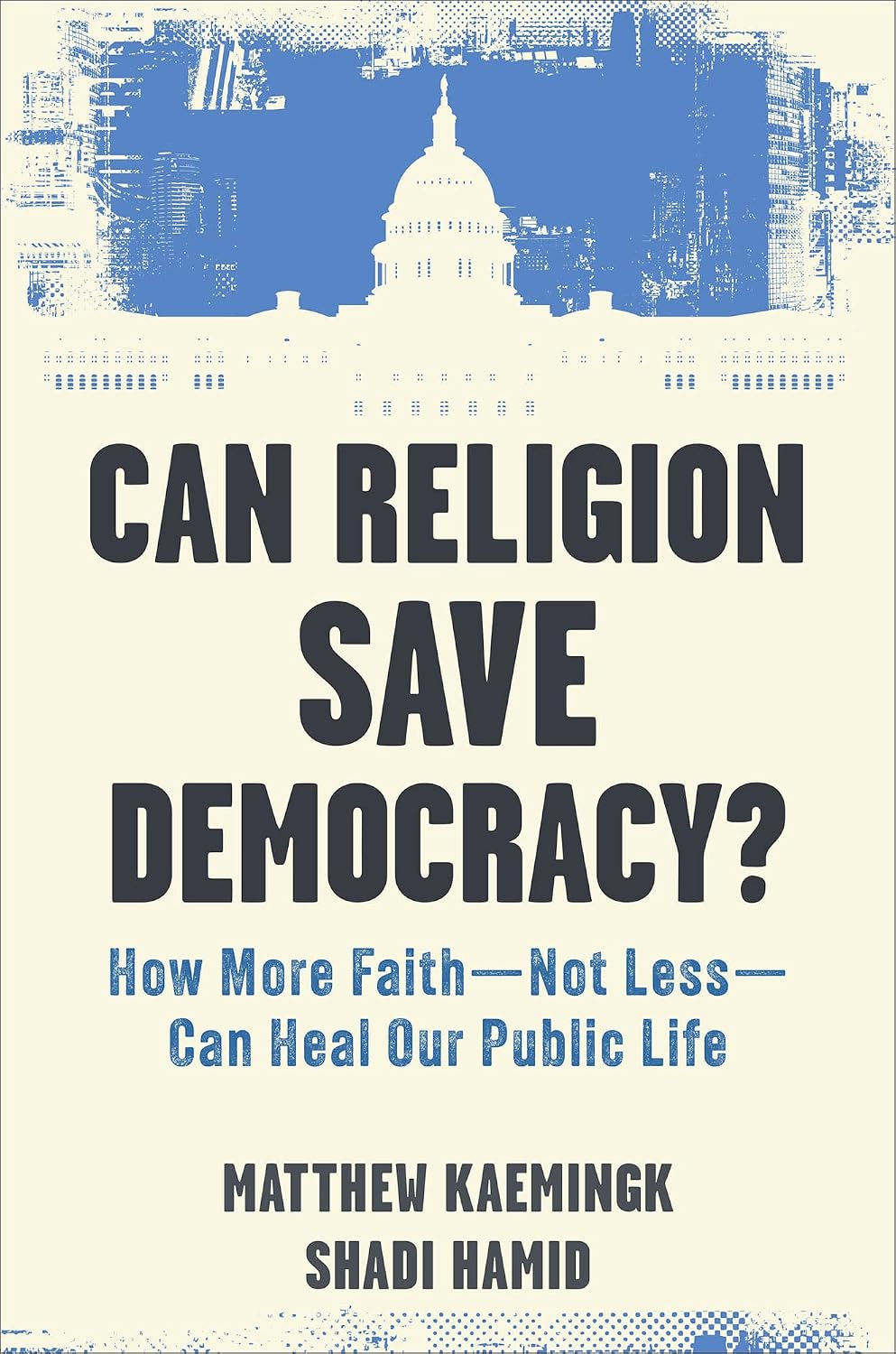
Can Religion Save Democracy?: How More Faith—Not Less—Can Heal Our Public Life
by Shadi Hamid & Matthew Kaemingk
Brazos Press, October 2026
The American system of government, President Eisenhower once said, “has no sense unless it is founded in a deeply felt religious faith—and I don’t care which it is.”
Today, few Americans who share Eisenhower’s conviction—and these days they are, overwhelmingly, Americans on the right—would regard with indifference the prospect of that religion becoming, not Christianity, or Judeo-Christianity, but Islam. Even conservatives who think Muslims should, in principle, be “natural allies” in the “ecumenical jihad” against secular progressivism are typically (and often understandably) leery about the commitment of many actually-existing Muslim communities to religious freedom.
Take advantage of our sale on annual subscriptions
so you can get FULL access to all of
Cracks in Postmodernity’s content
This makes the arrival of the new book Can Religion Save Democracy?, co-authored by the Calvinist theologian Matthew Kaemingk and the Muslim political scientist Shadi Hamid, a particularly delightful provocation. The notion that religion is a necessary foundation for democratic freedom will enrage much of the left; the idea that Islam should be co-equal with Christianity in this democratic shoring up will induce apoplexy among large parts of the right.
And Hamid and Kaemingk don’t pull any punches. “The culture war,” they tell us, “is the new Sunday school.” The decline of American religion over the last thirty years bears, in their view, a significant responsibility for the dysfunctional state of American politics. Religious communities—churches, mosques, and synagogues—channel our spiritual impulses in a healthy direction. Religion—actual, traditional, “organized” religion—appeals to mankind’s need for wonder, mystery, and ultimate purpose; and it schools those impulses into forms conducive to civic virtues like humility, tolerance, forbearance, and constructive disagreement.
Religion does all this because it achieves the Augustinian virtue of desacralizing politics and lowering its stakes to a less eschatological plain, in which we see political conflict as “serious but not sacred.” Our need for ultimacy is directed onto what is actually ultimate—God—and not onto conflict with our fellow man. We learn epistemic humility by hedging our arguments with the recognition that, as Muslim scholars put it, “God knows best”. Ritual formation reminds us at a deep “pre-rational level” that we are not divine and that losing an earthly struggle is not final: “prayer… is a daily concession speech”. Even belief in Hell, paradoxically, makes us less judgmental about one another’s flaws, since if true evil will be punished in the hereafter, we can easily face the prospect of its survival in the here and now.
Submission, in other words, is to God—and only to God. And citizens who adopt this posture of small-i islam are better citizens, less prone to attaching existential importance to political conflict, and more capable of recognizing that “truth belongs to God alone”.
But when religion (actual, organized religion) starts to die, the result is the kind of pathological approach to politics increasingly visible on both sides in America today. Both the hysterical blue-haired activist and the January 6 rioter are partisans who have made politics their God, and in doing so have made their party into an idol and their ideology into a two-bit creed.
So far, so good. Most of the claims are not entirely new, but Hamid and Kaemingk are not just rehashing Robert Putnam. Their accessible synthesis of religion’s civic virtue is sorely needed. And many of Hamid’s claims about Islam, especially, are genuinely insightful and rarely articulated. Indeed, as Western Muslims increasingly seek a healthier model of civic engagement, perhaps something like Hamid’s account of tawhid/monotheism and shirk/idolatry should be an important part of their emergent public philosophy.
Islam, after all, contains extremely powerful resources for, well, not immanentizing the wrong things. There is no doctrine of incarnation. No vicarious atonement in which salvation is secured through another’s sacrifice. No original sin, either—human nature, flaws and all, is exactly the way God planned it to be. Running through the religion is a passion for dismantling intermediaries (smashing idols, if you like). And this attitude could, and should, manifest itself in a deep skepticism of worldly orthodoxies, tribal loyalties, and political absolutism.
And yet… there’s something rather tiresome about the authors’ condemnation of partisanship, and their story of how we got here.
Of course, the principle Kaemingk and Hamid express is entirely correct. We indeed have “disordered loves… if we love our political tribe more than our neighbors”. We should indeed reject any “tribe, party, movement, or man” that claims “to speak for God with finality”. “Political certainty” is indeed a “dangerous drug,” which rots brains almost as fast as cannabis. Hamid and Kaemingk are not wrong, either, to identify contemporary America as at times tending toward an “existential politics”.
But this is about where my patience runs out. For what (or rather, whom) do Kaemingk and Hamid blame for our theologico-political crisis? Naturally, the culprit turns out to be the Religious Right. “Secularism became more attractive”, they tell us, “in part because of the uncompromising overreach of right-wing evangelicals in the 1980s and 1990s”. When religion was “manipulated” to gain power for conservatives, liberals switched off, left the pews, and forty years on the result is the slow death of real religion and its replacement by toxic political ersatz.
It’s hard not to be reminded here of the remark by that notorious secularist H.L. Mencken, to the effect that there is always a well-known solution to every problem—”neat, plausible, and wrong”. And this hoary old story, that Jerry Falwell’s ghost is busy throttling the churches (ever-so-attractive to the pro-religion left for what I’m sure are obvious reasons), is precisely that solution.
The first problem is that the Religious Right’s “overreach” was entirely relative. Constitutional amendments to ban abortion and restore prayer in public schools weren’t a plot to install theocracy: they would have done no more than restore something like the mild, pluralistic de facto American religious establishment of the early twentieth century—a time when religious practice was healthy and often rising.
So what made policies popular in the 1950s toxic in the 1980s? The answer is patently—and I hesitate here in awareness of how “partisan” this must sound—the actions of the secular left. That is, in other words, the set of vast, revolutionary changes in attitudes to religion and to a whole bundle of moral and socio-sexual issues associated with it that swept America, and the rest of the Western world, during the long nineteen-sixties. It was plainly these changes that coded the Religious Right’s mild restorationism as “overreach” and in turn provoked the secular reaction against organized religion.
The second part of Kaemingk and Hamid’s causal story fares even worse. Declining religion the cause of toxic partisanship? I’m sorry, but the slightest attention to the fate of Western Europe since the war makes this difficult to take too seriously. Britain, France, and West Germany began the 1970s with religious practice already similar to or below America’s level of the 2020s… and the result was, as we all know, a politics remarkable, by American standards, for their almost-complete absence of intense culture-war partisanship and affective polarization.
And when we consider the fruits of all this European calm and consensus, we get what ought to be a chilling warning. America is better than Europe on basically every dimension that matters. Britain, for example, is poorer than Mississippi. Europe is palpably less free. It is lazy. Its people do not build things; they only regulate them. No doubt, it can make for a charming vacation or comfortable retirement if you don’t have to pay the crippling taxes and earn the pitiful salaries. But it is not a good place.
Europe’s boring, low-temperature politics are a huge part of the problem. For while it’s easy to see the pathologies America has, we tend to miss the even worse pathology it lacks: consensus around objectively bad policies that don’t serve human flourishing. America has plenty of bad policies, of course; what it doesn’t have is Europe’s habit of politely avoiding controversy and culture wars. Every bad policy is, thank God, bitterly controversial and contested at every single step.
Let’s disentangle this a bit more cleanly. Consider Hamid and Kaemingk’s basic complaint against polarization. They claim that when “political affiliation determines our choice of romantic partners and neighborhoods, we lose our capacity for democratic deliberation” and regret that “the moderate religious center has not held.” In other words, they oppose both affective polarization and partisan sorting.
Loving your neighbor is, of course, good; hating him because he’s a lib is bad (full marks to Kaemingk and Hamid here). What political scientists call negative affective polarization is a dreadful idolatry. But positive affective polarization—loving your own side more, and actively seeking out friends, colleagues, and spouses who share your ultimate political and religious values—is a good, sensible response to the stakes involved. And we don’t have to marry libs just to maintain our capacity for deliberation, as long as we’re still prepared to discuss and debate the other side.
And we can go one step further: partisan sorting is good, too. It is a good thing when parties, candidates, and voters line up neatly along cohesive ideological lines. (“Oh!” runs the common objection, “why should your views on abortion correlate with your views on marginal tax rates? What has Chicago to do with Jerusalem?” Quite a lot, actually: economic and social conservatism are correlated in almost every democracy because both involve accepting hierarchy of some kind.) When each party represents a clean ideological package and not a heterogenous blob of compromises, voters get real choice and real accountability.
What sets America apart from Europe is its conviction that ideas have consequences. And if we take that conviction seriously, it makes absolute sense that we’d prefer to befriend, date, and marry people with similar ideas; and that we want elections to predictably empower ideas, too.
Europe’s long attempt to pretend ideas are inert is now coming loose in its frankly contemptible implosion over immigration, “identity”, and Islam. While the naivety of the multiculturalist left is obvious, the identitarian right’s rejoinder (an appeal to the brute, atavistic fact of genetic ancestry) is equally imbecilic. America is in a far healthier position—-and its polarization is partly to thank.
Hamid and Kaemingk’s fundamental error is overreach. They correctly observe that, for religious believers, politics cannot be ultimate or “sacred”. They wrongly deduce from this that politics should be “mundane”, “peripheral”, and “delightfully boring”. Not so: the excluded middle is that they are penultimate. Not the first things of the moral universe. But certainly not boring—and more than worth a bit of residential sorting.
Pat Buchanan declared (in an era Kaemingk and Hamid bizarrely remember as “calm”) a “war… for the soul of America.” Thirty years on, we are still fighting that war—and, insha’allah, we always will be. For the things societies go to war over are the things they truly care about. And what, at the end of the day, could be more worthy of our care than the state of the nation’s soul?
 | A guest post by
|
Williams’s distinction between penultimate and ultimate commitments gives political disagreement its due. But caring about the nation’s soul includes recognizing one’s own side’s failures. Religion earns its civic keep when it enables that admission. Williams underestimates how surrounding ourselves with allies can conceal those failures and make debate with opponents seem pointless.
I’m puzzled by the statement that “economic and social conservatism are correlated in almost every democracy because both involve accepting hierarchy of some kind.” It would seem to me that this is only really the case in the US—in most historically-Christian locales, it seems that both social conservatives and secular progressives agree on economic policy that the American right and even center would consider “leftist,” and furthermore that when societies such as Germany debate between their “centrist” economics and more robustly left policy, both of which are to the left of what American “liberals” have instituted since the 1980s, it is Christians who defend the more robust labor-left policy, and secular liberals who are a bit more laissez-faire.
I also don’t understand how this maps onto hierarchy—conservatives do indeed favor hierarchy more than most others, but Catholic, non-Calvinist Protestant, Jewish, and Muslim traditionalists tend to believe that the way economic hierarchy shakes out in a “free market” situation would not naturally sort into a just hierarchy that corresponds to God’s will or moral “deservingness.” They believe in other kinds of hierarchy sorted by other means. Only Protestants from a Calvinist tradition tend to believe that when left to market forces, people will in fact end up in economic situations they “deserve,” that can even be taken to be fruits and signs of how much they are favored by God above. Almost every other monotheistic religious tradition considers this so misguided as to be evil and even blasphemous, which is why those who favor laissez-faire economic policies in the US (to an extreme degree à la Rand, Goldwater, and Reagan) tend to be either godless, greedy, secular folks OR conservative Christians from a Calvinist-leaning tradition. There might be a few Methodists or non-Calvinist evangelicals or bizarrely-misguided Jews or Catholics who misunderstand their own traditions’ teachings at the margins, but it’s mostly secularists and Calvinists.
Outside the US, what Americans think of as “economic conservatism” is a much smaller fringe of aspiration, and much more rarely makes it into settled policy. So perhaps many of what Williams considers features of the American situation are actually bugs…especially if one fears God and does so from anything other than a conservative Calvinist vantage point.