Mangione, Mishima, & the Ethics of ‘Basedness’
can acts of violence incite hope for change?

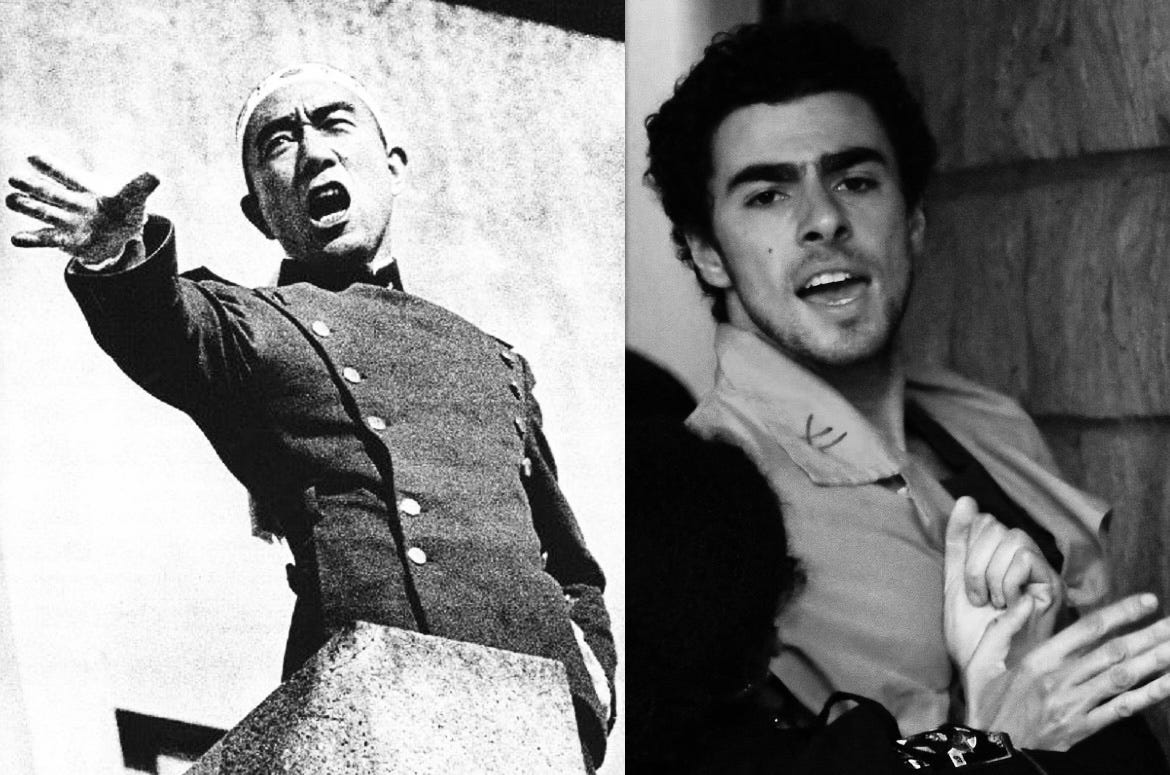
“We live in an age in which there is no heroic death,” lamented Yukio Mishima in a 1966 interview for NHK Television. For the writer, the life of leisure and individual consumerism that came with his country’s post-war industrialization had severely limited his kin’s duty to tradition and will to glory; Japan’s material prosperity was developing in opposition to the spiritual wealth it once had, to the virtue of sacrificing your labor to your community. In rejection of this, Mishima staged a coup that was quickly rejected by Japanese troops, after which he disemboweled his guts with a sword.
When many decades later Luigi Mangione (allegedly) shot UnitedHealthcare CEO Brian Thompson, I couldn’t help but think of Mishima’s final hours. As evidenced by Valerie Stivers’s recent essay, I certainly wasn’t the only one. The spectacularity of both gestures—which involved, in Mishima’s case, a uniform modelled after the WWII-era Imperial Japanese Army, and in Mangione’s, bullet casings with the words “deny, defend, depose”...as well as the nationwide crises that motivated both incidents—had, to my eyes, a strong resonance.1 So does the masculine, muscular build of the two men.
Did both of these men expect their actions to be catalysts of revolutionary fervor? It’s hard to say. But it’s quite striking to note the way that both men have garnered admiration among left and right-wing circles that are anxious for change.
Mishima was a strong critic of the capitalism that was unfurling in his country, but he was quite anti-communist. Nonetheless, just as Japanese New Right groups frequently invoke Mishima as an inspiration, Reddit forums explaining his appeal to socialist folks and Gore Vidal’s eulogy of him show us how his legacy has transcended political barriers. As for Mangione, despite his fascination with the Unabomber, his admiration for Jonathan Haidt, and his interest in some of RFK Jr’s ideas, his act of rebellion against a profit-oriented, inaccessible healthcare system has inspired sympathy in progressive commentators like Taylor Lorenz, just as it has in folks who frequently view Ben Shapiro’s videos.
Put simply, both of these folk heroes are alluringly based. Yes, “based”...as in the term Zoomers drop in comment sections of TikTok edits of strongmen of both the left and right, like Donald Trump, Lee Kwan Yew, Josip Broz Tito, and Fidel Castro.
Per Lil B, the cloud rapper that coined the word, “based means being yourself. Not being scared of what people think about you. Not being afraid to do what you wanna do. Being positive.” Yet the term gained wider use, while still at the margins of the mainstream, a handful of years after the rapper’s acclaim in the early 2010s in far-right online circles in a manner devoid of its original positivity—maintaining, nonetheless, authenticity as its central meaning.
In X, Reddit, and 4chan threads, the term would be used in reference to news and clips of people defying political correctness; or, as for historical figures, defying our current understanding of human rights. Nowadays, based has transcended illiberal right-wing forums to be used in everyday speech by twenty-year olds across the globe, as well as in progressive scenes that find respectability politics exhausting. Therefore, per Sal Hagen and Daniël de Zeeuw’s exhaustive analysis of the category, “there exists a base meaning of based which is ethical more than political.”
Now, it is worth mentioning that looking up “based edits” on YouTube also leads to many videos centered on Western Civilization and Christianity—videos that interpose cathedrals and Greco Roman busts with scenes of war and military might. There is, I believe, an element of violence that underlies the rawness of life that based folks express through their indifference to good manners, be it in speech or in action. No matter how harshly a gallant UN officer may scold a political leader, their unwillingness to exercise or justify violence would never make them based.
Desirable or not, the recognition of death as an unavoidable reality of our actions and, ultimately, of our time on Earth proves tempting for those that seek basedness in their preferred web browser.
Which brings me back to Mishima. In his novel The Temple of the Golden Pavilion, there’s a scene where Kashiwagi, a friend of the protagonist, says that “to see human beings in agony, to see them covered in blood and to hear their death groans, makes people humble.” And isn’t humility, per the teachings of Catholic theologians, not self-belittlement, but rather an acceptance of our reality as it is—a rejection of the fictions and fantasies that follow pride? The Virgin Mary is supposed to be “blessed among women” in part for her bold assertion that her son would “scatter the proud in the conceit, put down the mighty from their seat, and send the rich away empty away,” and “exalt the humble and lowly.”
Is this hunger for based renegades who eschew the empty rules of respectability a sign of our having become morally base (in the conventional sense of the term)? Noble ends rarely justify vengeful violence as a means.
Yet it would be too easy to condemn those who applaud Mangione’s violent act with a broad brush. There’s something to be said about the fact that Mangione’s fandom has emerged in the midst of a society that has been overtaken by social media and that suffers from rising social isolation, from narcissism and perennial self-victimization, from inescapable entertainment and profound ennui. It could be argued that the path of destruction brings some sort of comfort to many that find their feelings distorted by what they see occurring in the news—which seems to bombard us every every minute of the day—and the mostly unchanging everyday life they lead as they stop in the supermarket on their ways home from work.
In a word, such acts of violence incite us to hope that something can actually happen…that things can change in our stagnant society. Perhaps said hope for change is only illusory, and said change might actually turn out to work against the common good. Yet in times like ours, it’s hard not to latch on to even the most bogus promise of hope.
Perhaps that’s one reason Mangione has amassed such a following: because the Brian Thompson incident instilled some fear—and perhaps some humility—among folks that seem to think their positions of power are immovable, thus giving hope to those who are disillusioned with the system that things could quite possibly change.
In that same monologue, Kashiwagi says too that “it’s on a beautiful spring afternoon (…) that people suddenly become cruel.” It is true that the beautiful spring afternoon the liberal consensus of the nineties and early aughts imagined life would become has failed most Americans and citizens of Western countries: The standard of living that was accessible to many blue-collar workers decades ago is impossible to imagine nowadays. But the wide array of material comforts that have resulted from that era pins us to the grass in evening time, finding no fulfillment while working in the morning, unable to sleep.
I guess, then, that some of us resort to applauding basedness—even in its cruelest forms—because we intuit that there’s something heroic, and in a certain light, virtuous, about such disregard for empty moral platitudes. Cheering on Mangione’s crime feels, to many, like an effective way to channel our rage toward a social paradigm that we are told is “developed,” but that in reality feels so unbearably mid.
One hundred years ago, Yukio Mishima was born under a different name in an Imperial Japan quite different from how the country would be described today: a tourist paradise, a tech-and-media titan, a nation facing extinction from low-fertility rates. Fifty five years ago, he killed himself under the cries of baka from soldiers who found his intentions pretty anachronistic. Maybe if he had attempted his coup nowadays, things would’ve turned out differently. Or maybe, as people in America continue to wait for a more accessible and affordable healthcare system, nothing would’ve ever happened.
Even if the hope for change that based figures like Mishima and Mangione provide is just another simulation—a hollow and impotent meme—in the “hyperreal” matrix of our society, we’d do well to let them incite us to search for the source of real hope, for the means of substantial change.
Interestingly, Mangione himself had expressed concern about the state of Japan on previous occasions; he had mentioned to Gurwinder Bhogal over video-call that, although “he loved many aspects of the culture there, such as the sense of honour,” he found it a dystopia of sorts, where “people had lost control over their lives, becoming mindless slaves to stimuli,” such as the hikikomori, “who spend their lives alone in their bedrooms, sedating themselves with video games, porn, and other shallow entertainments.”
 | A guest post by
|
You have an incredible amount of institutional privilege to think Mishima and Mangione belong in the same bucket, and that the right and left celebrate both equally.