The Decline & Fall of the Sabbath
Blue Laws liberate workers


This Easter, two old friends of mine came through town. They wanted to get brunch. But this is Indiana—would any place be open on Easter Sunday? It was a foolish question to ask. In the United States, if you want to spend money, no one and nothing is going to stand in your way. Since we could get brunch, we did. But I couldn’t shake the feeling that we shouldn’t have been able to do it. At the very least, it should have been much harder than it was. Why was it so easy? This is Indiana! Until 2018, you couldn’t even carry alcohol out of the store on a Sunday. And now you can get brunch? On Easter?!
When I went to university in the UK, you had to pay attention to what day it was. On Sundays, most shops were open for no more than six hours. The British calendar is also populated with numerous bank holidays that are widely observed. These are great days to walk around and get fresh air. Many people go for picnics in the park. But it’s best to plan ahead a little and buy your food and drink ahead of time.
Last year, I spent six weeks in Germany. There, they have something called the Ladenschlussgesetz, or “shop closing law.” This law strictly regulates when different kinds of shops can be open. It produces a Sunday that is markedly different from other days of the week. Many shops do not operate at all, and if you run out of food at home, you can genuinely get into a bit of trouble.
Now, this might strike you as rather odd. After all, the Germans are much less religious than the Hoosiers I know back home. Less than half the population of Germany believes in God, and only 10% believe in God with “absolute certainty.” By contrast, in Indiana, more than half the population not only believes in God, but is quite sure about him:
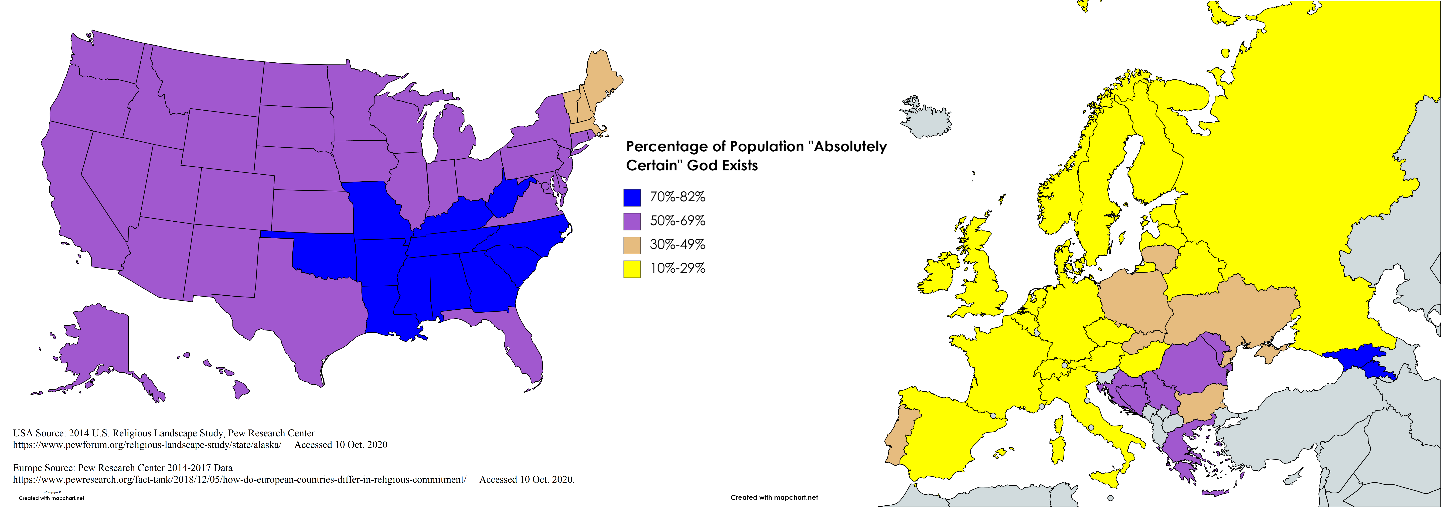
Why, then, does Germany keep the Christian Sabbath while Indiana does not? The Ladenschlussgesetz is an old-fashioned blue law. Blue laws prohibit various forms of economic activity on Sundays and other holidays. These prohibitions protect workers from pressure to come in on sacred days. Without them, workers who refuse to come in on Sundays can be passed over for hiring or for promotion.
To compete for jobs, workers accommodate their employers, and before long Sunday is no different from any other day of the week. In this way, unregulated competitive labor markets produce a situation in which everyone has to work on Sundays regardless of whether anyone wants to. The only way to stop this dynamic is to have a law that prevents employers from making workers compete with each other in terms of Sunday availability.
Blue laws came about through an alliance between Christians and Socialists in the early part of the 20th century. By the late 19th century, German workers had absurd schedules—the average factory worker had a 72-hour week. German churches noticed Sunday attendance dropping, and they began advocating for legislation to defend the sanctity of Sunday.
Pope Leo XIII became a champion of these initiatives. His 1891 encyclical, Rerum Novarum, insisted that the state had an obligation to protect Sundays. The Chancellor, Otto Von Bismark, had long opposed Sunday closing laws. But when the Kaiser fired the Chancellor, this allowed for the passage of the Workers Protection Law. The law not only closed shops on Sundays, it even closed steel mills. By 1900, the average factory worker had a 61-hour week. By 1913, this had been further reduced to less than 56 hours. Sunday closing laws were subsequently enshrined in the German constitution of 1919 and in the basic law of 1949.
By the 1950s, there were concerns about German industrial competitiveness. After all, American steel mills didn’t shut down on Sunday. So why should the German mills? There was an attempt to make a compromise. Each steel worker would get two days off per week, but they wouldn’t all get the same two days off, and each worker would only be promised nine work-free Sundays per calendar year. While the labor unions were willing to consider these sorts of arrangements, provided they reduced overall working hours, the Catholic bishops of Germany were horrified. In 1952, they made their position clear:
“It is mistaken to base decisions that affect ethical and religious values on the criteria of whether steel production rises or work hours can be reduced. It is essential to take account of the values that fulfill and elevate humanity, especially in this age threatened by materialism.”
Many Protestants, however, were willing to support the compromise. In isolation from their Christian allies and from their allies in the labor movement, the Catholics were powerless to prevent reform. They were conceded an additional four work-free Sundays per year, but the factories would be allowed to run continuously. It was agreed that this was compatible with the German basic law, which allowed for the possibility of making exceptions to Sunday closing laws on grounds of technical necessity. However, since there was no technical reason shops had to be open on Sunday, most would continue to remain shut.
The fight over Sunday greatly damaged the relationship between the Catholic church and the German labor unions, diminishing Catholic influence within the German labor movement for decades to come. Still, the compromise struck in the 1950s retains considerable purchase. When Germany was reunified, the atheistic states of East Germany adopted the Sunday closing laws. But their admission greatly reduced the influence of Christianity within Germany. Exemptions to the Sunday closing laws have slowly proliferated, and enforcement is, by all accounts, not as strong as it once was. Without socialists or Christians to defend them, one wonders how long these unenforced norms can last, particularly when there is so much money to be made by those who find a way to quietly forget about them.
Blue laws proliferated in the United States in the late 19th century, too. But in the 1960s, the Supreme Court ruled in McGowan v. Maryland that blue laws were only permissible if they did not have a religious purpose. While it was acknowledged that many blue laws originally had a religious purpose, the court’s majority argued that this had since changed, and that some blue laws could now be justified on secular grounds. However, in practice, many states had written blue laws that struggled to pass this test or had inconsistent prohibitions that were difficult to explain in court.
So, the court’s ruling produced a consolidation of blue laws—many of them were replaced with laws that restricted only the sale of alcohol or vehicles. Today, only Bergen County in New Jersey retains a full suite of blue laws in their strong form:
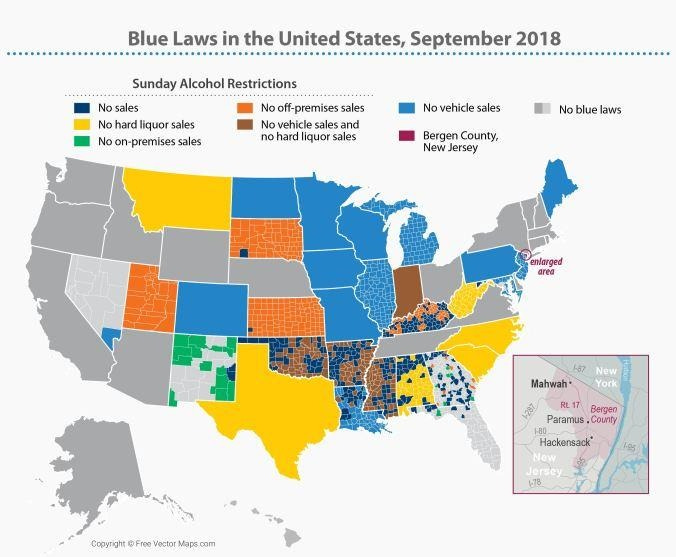
The repeal of the strong blue laws in the United States had statistically significant effects on church attendance, significantly reducing the frequency with which people attend services. Significantly more Americans now work on the weekend:
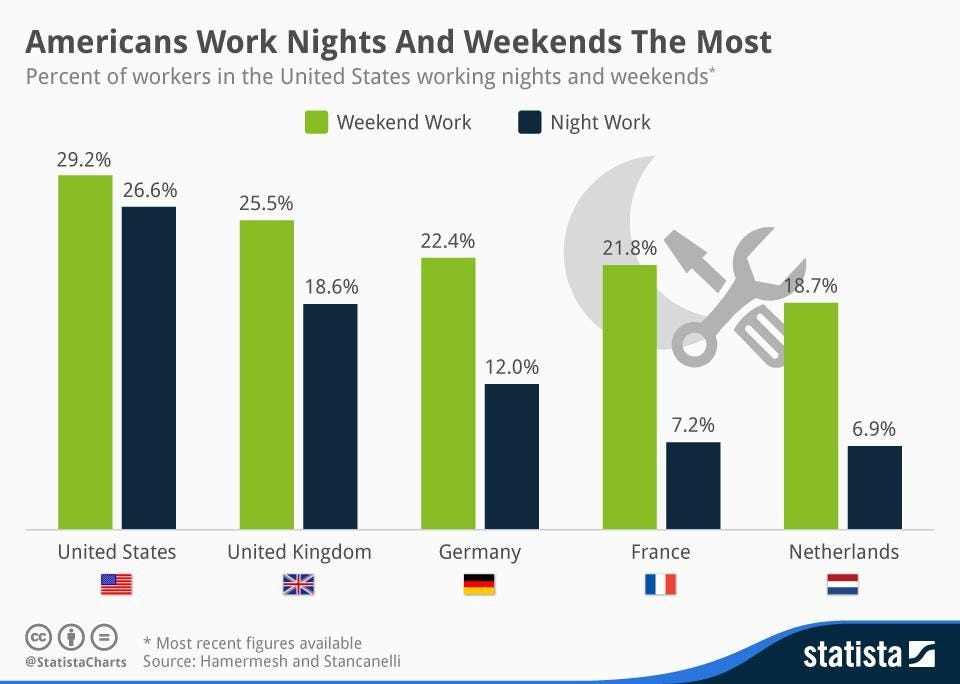
Many workers in the gig economy use gigs to supplement their regular income. The numbers rise even higher if we focus on American workers who hold multiple jobs—49% of them work on the weekend. And when you consider that the weekend is the peak period for affluent Americans to go out and travel, it follows that Uber and Lyft drivers are especially likely to spend the weekends stuck on the roads.
At the same time, the repeal of the blue laws also has a statistically significant effect on the consumption of not just alcohol, but also marijuana and even cocaine, particularly among those who are church attendees! This suggests not only that religious organizations and workplaces compete for people’s time, but that even those who do not work on Sunday and are religious are more likely to spend the day consuming if this option is made available to them.
And once your friends want to get brunch, it becomes a little difficult to say no. If it’s thus for brunch, why not for cocaine, too?
In Germany, it was understood that if you made rules for everybody, it would free people from forms of competitive and social pressure that would lead them to do things they might, upon reflection, prefer not to have done. That understanding was produced through a protracted deliberation involving both religious people and socialists. It is only once the power of religion and labor are broken that this understanding can come undone.
In the United States, progressives and conservatives want nothing to do with each other, so judges adjudicate their disputes. The courts tell us what kinds of laws we can have, and then individual Americans are blamed for the free choices they make. But real freedom requires some respite from the pressure to spend all of our time working hard and playing hard. As long as it is identified principally with the right to work and the right to consume, freedom will remain a kind of cage.
 | A guest post by
|
Thanks for this. As an old-school labor-lefty and a religious believer, giving workers a break provided their pay for the rest of the week is sufficient is always good. Making sure people aren’t pressured to work on their sacred days is even better!
But there is a complication. I am a Reform Jew, and 3/5 of the way through rabbinical seminary to boot. My denomination was founded on relaxed strictness of such things as Sabbath restrictions. But for those religious Jews who keep to more traditional restrictions for reasons of conscience, the relaxing of blue laws has been an immense relief in many cases over the past few decades. For more traditional Jews, Sunday is the only weekend day on which they are permitted to engage in any economic transactions for business or leisure. Movies, restaurants, groceries, Home Depot, whatever.
Surely, there must be a way to capture some of the benefits of blue laws without stepping on the toes of those with a different Sabbath. Especially the one Jesus of Nazareth observed 😉. Or Friday for Muslims. Or whatever.
Good piece! Three cheers for suburban Bergen County! Maybe something good can come From the “burbs?” LOL 🤣