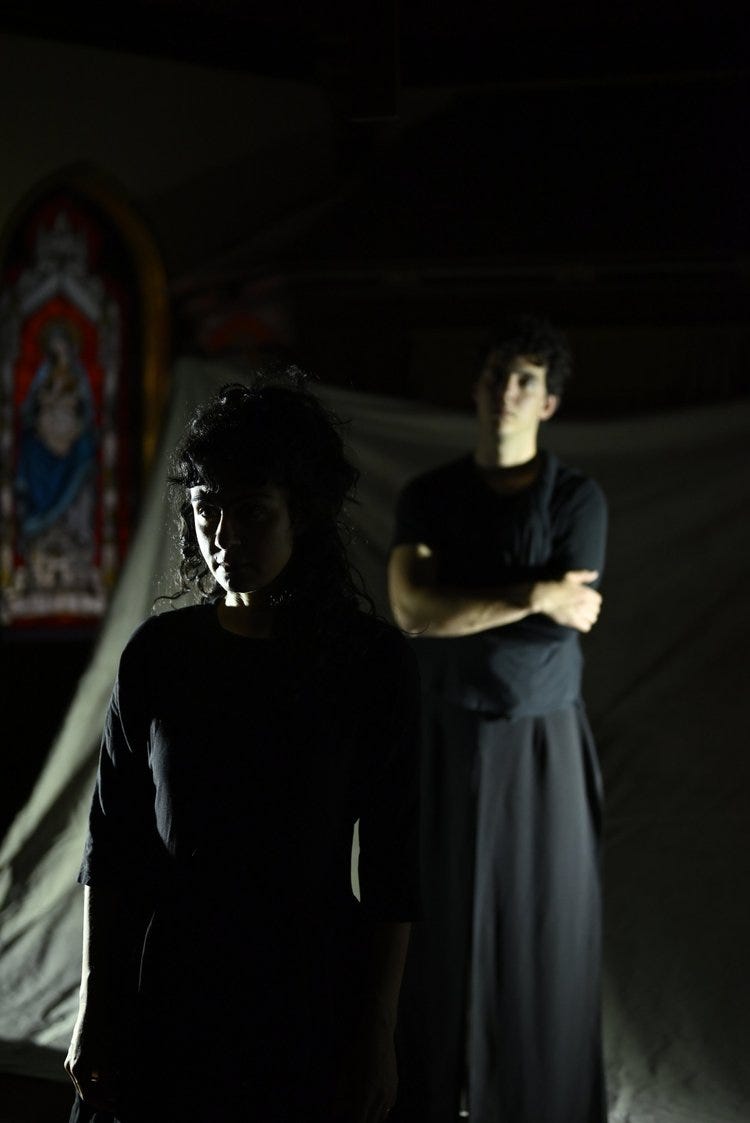
The ghost that haunts Hamlet, his father of the same name, disappears as soon as the cock crows in his first appearance in Shakespeare’s play. A prophecy is fulfilled in that moment, or rather a truth unveiled. The ghost cannot be seen in the light of day. It tells us what it is, and where it remains: purgatory.
It’s in the despair of what cannot yet be seen that we find ourselves in Ghostcreator, the latest play by Karina Pooran Majewski. This same ghost, whether materialized as an onstage presence, a voice recording whispering behind curtains upon curtains, or some other entity that is captured in the mysticism of theatre, is given a voice to air its suffering. Rather than giving advice, or asking people to perform a seance to bring it to life, it lays where it must be for the sanctity of its salvation.
I had seen the play mere hours after attempting some form of theatrical catharsis myself after my father’s funeral, which had been earlier that day. The Mass went as unremarkably as it should; a Memorial to a Man who had never lived as a Catholic; rain poured endlessly on the apathy of the day. I tried to muster the courage to eat Korean food and do karaoke to no avail. Nothing reminded me that something had happened to the state of my Father’s soul. I took the immediate next train to Park Slope to the dilapidated, formerly functioning Catholic chapel to see Ghostcreator.
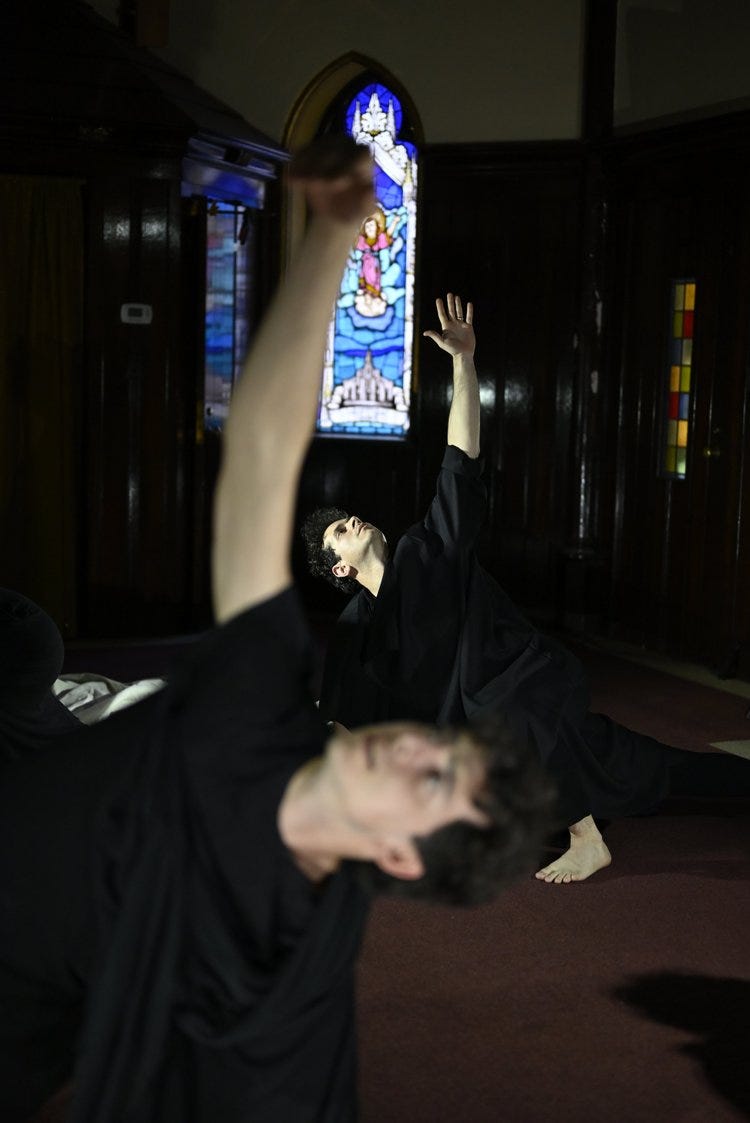
To call Ghostcreator an acknowledgement of the healing fires behind purgatory would be a little off. I would be neglecting the Holy Spirit’s very visible, tangible and obvious presence in the play. Lord, the giver of Life, who proceeds from the Father and the Son. But He will come towards the end, once this muck in our own sentiment had been dug up and frightfully frisked for any loose ends that would deny our eternal home.
Ghostcreator begins with its nameless cast digging endlessly towards a corpse holding onto another one. “Dig like Adam, get in there,” the progenitor of Man, whose lie created our corpse(s). The corpse they eventually dig up, that of Ghostcreator‘s director James Majewski, inverts Hamlet’s “To Be or Not to Be” into “Too late to be, or not, that Is.” The ghost of Hamlet comes and goes with an unholy request for revenge. The temptation of fulfilling it is succeeded by a greater desire: to be ghosted. That is, every member of the six-member cast eventually puts on white face paint, based on their own accord or at the hand of someone else. Stage makeup becomes the anointing of the actor to the vocation on the stage. When each member of the cast becomes “ghosted,” they’ve come in agreement to meet the Holy Spirit in some type of way.
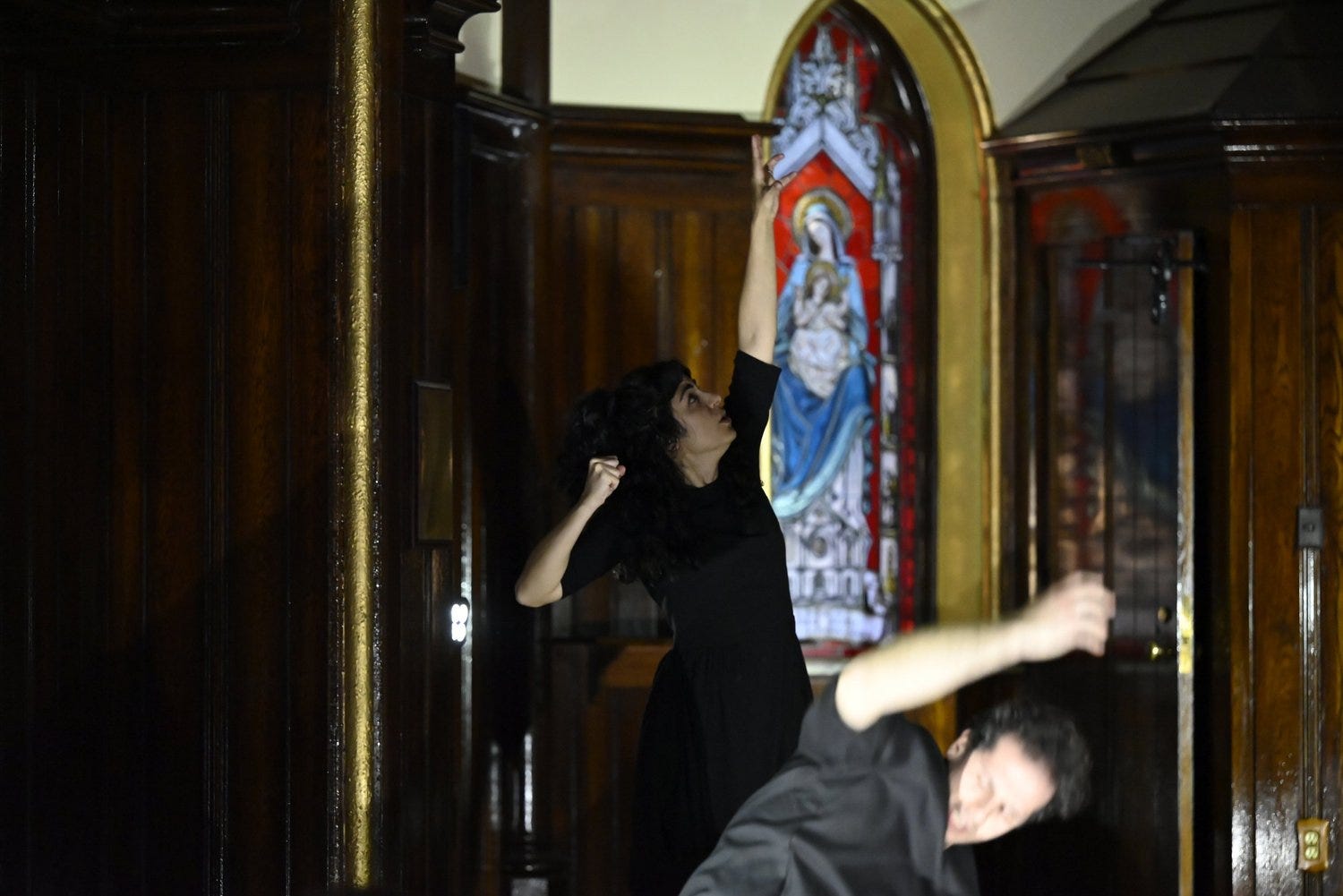
The inclusion of traditional hymns, by the anonymous chorus of sinners turning saint, embodied the cramped space of the chapel and expanded its potentiality. The world of their seclusion, acknowledging a perfumed presence on its way to rescue them in their darkness, becomes larger. While the cast spins, stomps and runs about the chapel, the viewer’s land expands. You’re part of their benevolent suffering, too. You should pray for them, too.
This pained chorus commits to vignettes of repetition, where the individual players acknowledge their inner rot, or the impending light illuminating their hopeful anxieties. In one poignant scene, Lydia Brinkmann and Sharbel Habchy share a dance, trapped in a kitschy music box. Lydia, drenched in water and sopping wet, approaches Sharbel, who holds onto the mask of a mannequin. Their exchange and methodical spinning, trying desperately to reach a lover who refuses to believe in their own goodness, is punctuated by the surreal audio of an Amazon review of a music box that plays “Fly Me to the Moon.” The audio punctuates the artifice of creating the set, bridging together the sparse economy of the play within the confines of the chapel. There has not been a luckier coincidence of setting and script.
It was by this point in Ghostcreator that the encroaching inevitable, a certain moonlight, a Lady, had begun to spread her veil across the play and invite you to meet her spouse. The journey to introducing her friends to Him is heartbreak upon heartbreak, realization that someone is coming but the patience is unbearable. What are we doing, as the viewer, to alleviate their struggle? Do they choose to writhe for us?
During the Q&A after the performance, I brought up the place Ghostcreator took me, the harrowing Hall of Champions of the Bosom of Abraham. I had placed myself there, where Christ had descended to take the prophets before Him to Heaven in the time He lay in the tomb. Until the image of the Light is complete, one could not possibly understand what lies before them. You leave with exhausting, fanatical respite.