We Still Need God in Every Moment of Our Lives
the deactivation & rebirth of @ineedgodineverymomentofmylife

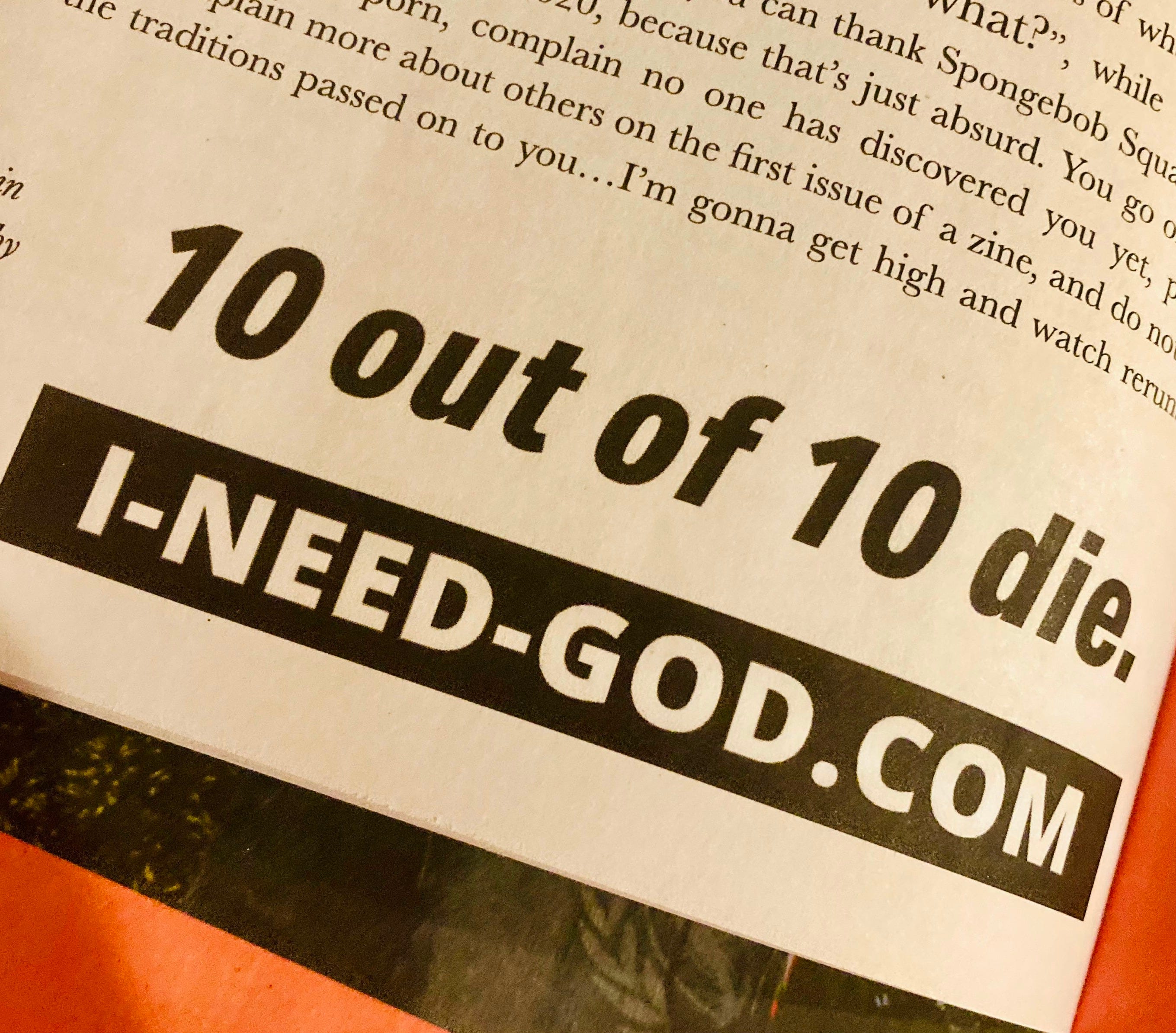
The week before last was marked by a rather cataclysmic event for a very particular niche of online Christianity — the beloved meme page I Need God In Every Moment Of My Life was deactivated by Instagram.
The ostensible reason was “copyright violation”: but this is a perplexing charge against a meme page — and, more generally, a paradoxical claim in a moment when generative AI is radically destabilizing concepts of authorship, self and creativity. Since there’s no one at Instagram to appeal to, but more bots — to whom does one appeal? Ultimately, to God: or specifically, one could sincerely pray for the intercession of Carlo Acutis, the saint of the digital, that against all odds the account might be restored.
At its height, @ineedgodineverymomentomylife had over 136,000 followers, and was — and remains, though now with fewer followers — a go-to place of encounter for expressions of faith that are alternately, or simultaneously, ironic, provocative, comforting and bizarre: from reposts of glib yet bracing tweets (“divine intervention is real. ❤️ God is making my life harder”), to an inventory of “biblically accurate Sanrio characters”, to an image of a crucified minion (which can be purchased as a bikini — “were you there when they Gru-cified my Lord?”)
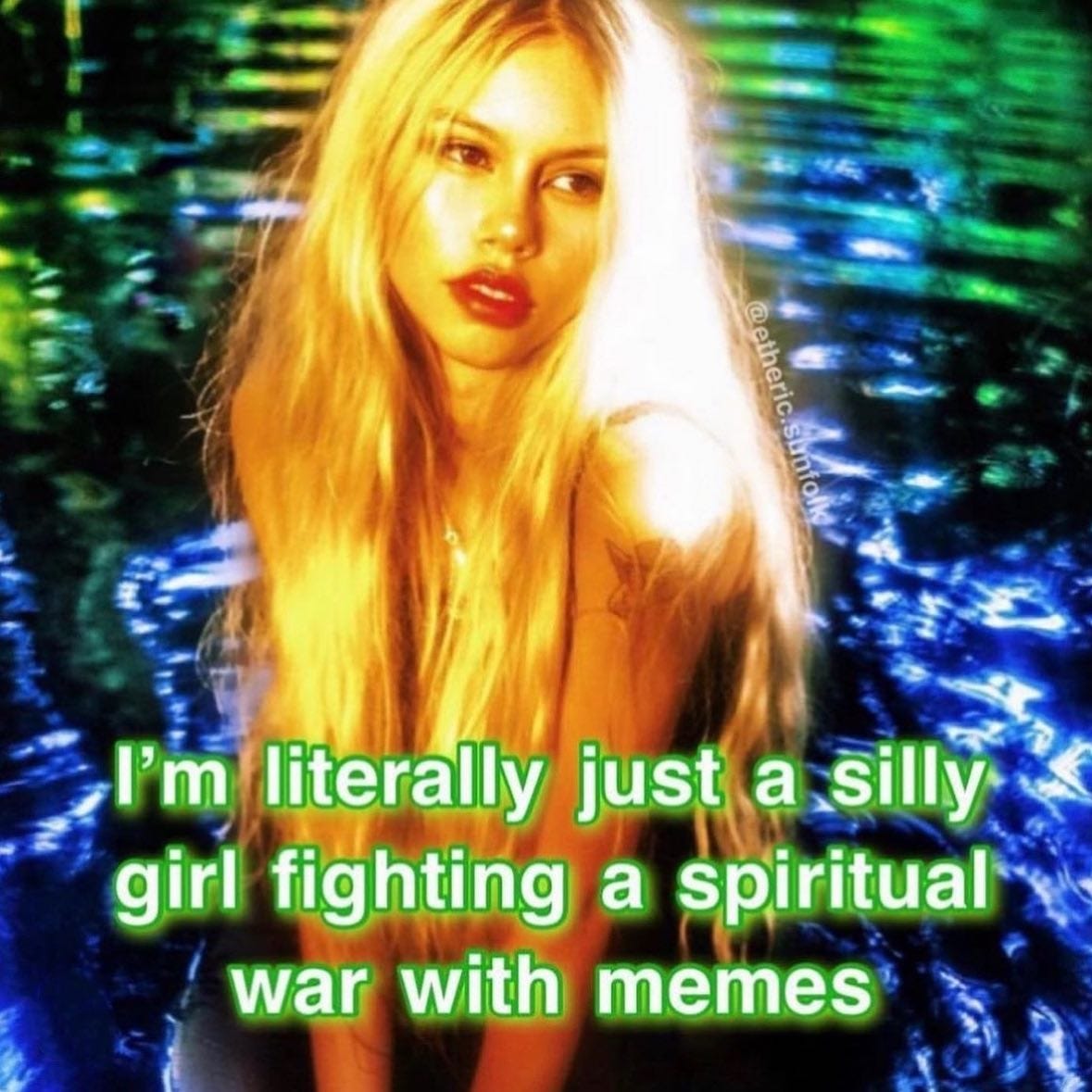
Depending on one’s theological disposition, cultural context, or relationship with religion, these may seem like irreverent, or at least odd, “expressions of faith” — but to a subset of Christians with a particular array of aesthetic and philosophical sensibilities, myself included, I Need God’s strange and charming intersections of faith, pop culture and internet absurdity have often tended to feel more honest, sincere, and spiritual than many of their unsatirical counterparts in the Christian and Catholic algorithms.
Hence, its deletion is not just a blip on the subcultural radar: these accounts, and their influence, matter — because they shape the way people actually experience their faith. It is an age in which religious content is not just an ancillary means of transmitting religious ideas, but a principal space in which religious experience unfolds. Digital Christianity is Christianity, at present, as much as any of its other domains of discourse.
And, as someone who’s been examining these things, and whose feed is therefore flooded with myriads of Christian influencers who often blur the line between evangelization and self-branding — when I Need God has popped up in my feed, it has almost always come as a moment of spiritual relief: a moment of God actually breaking through the algorithmic religiosity, in the playful inscrutability of a given image, witticism or gag, rather than another talking head talking about Him. Amidst all the ideologically motivated content in this space — trads, libs and all in between telling you what to believe or performing faith in a certain way — it has often shone through as a kind of theological interruption, offering a little digital nugget of the irreducible mystery of things: “here’s this”.
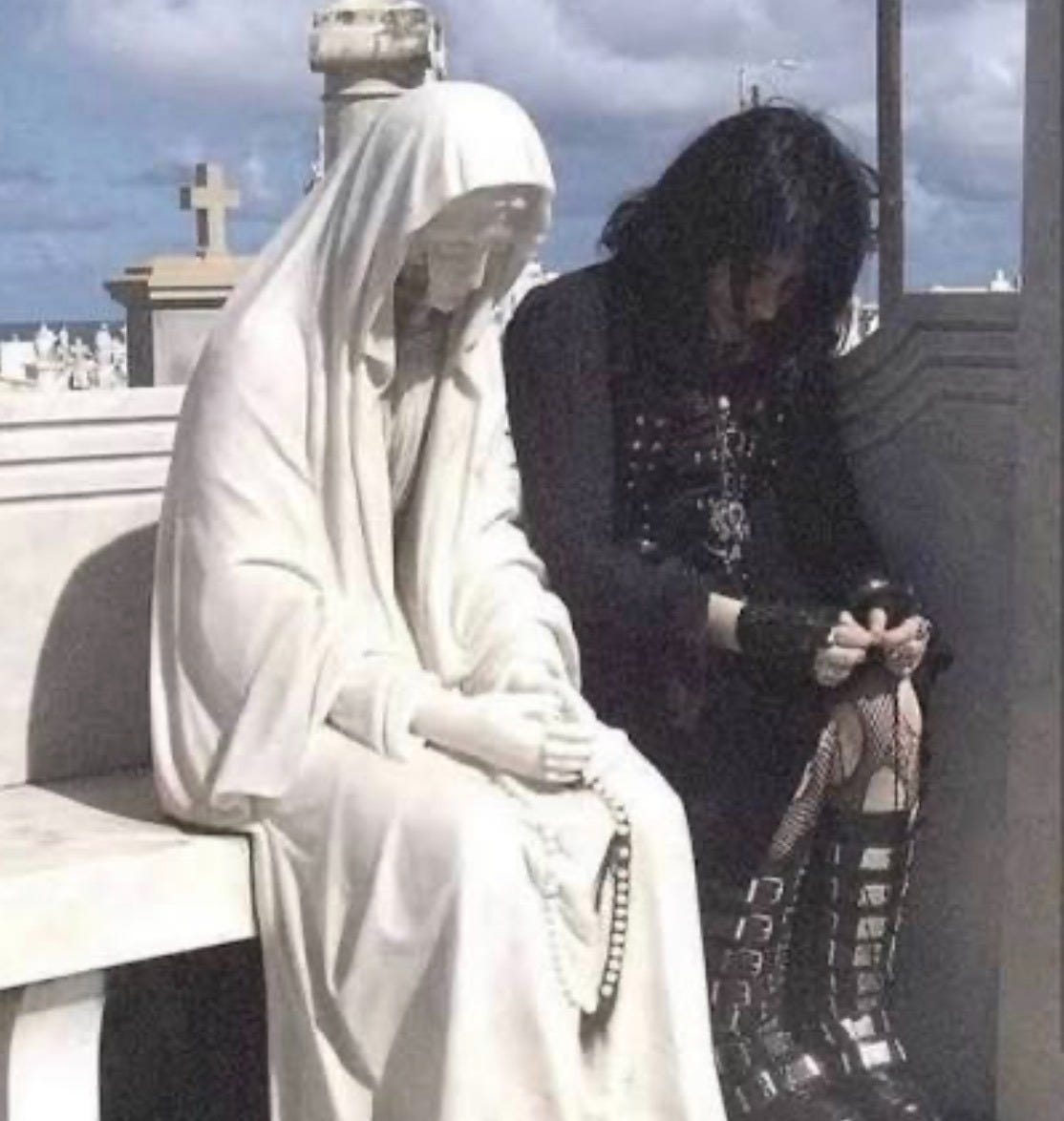
I recall a favorite of mine: a pic of a pensive young goth sitting next to a statute of the Virgin Mary in a Puerto Rican cemetery. I remember scrolling across it and being like: well, whatever else is going on — whatever culture wars and identitarian inanities contort the collective spirit and the body of God — at least there’s this goth, and Mary, in a cemetery. Simply captioned “mood today”, it was at once a striking juxtaposition to whatever the hell else I was scrolling past, an implicit nod to the complexity of Christian subcultures, and a genuinely stirring image of prayer. In a medium where traditional piety can become performative vanity, the ironic detachment of a wordless image can paradoxically be more sincere than the most devout digital proselyte, because it makes the viewer aware of the contingent nature of the medium itself.
And yet, among all the many Christian accounts that are currently crowding digital space, this is the one that Instagram chose to take down. For a company that calls itself “Meta”, it exhibits relatively little meta-awareness.
For more than 8 years, familiarity with I Need God has been something of a shibboleth for a certain continuum of contemporary Christianity, one marked by self-awareness and reflexivity — or one might say, a “metamodern” sensibility of being at once “ironic and sincere” — a faith that delights in beholding, in the curated meme, the variety, strangeness and occasional paradoxicality of religious expression in the hypermediated age.
The account was the creation of curator Kyle Hide, and was originally born of a group chat between him and his friends Melanie, Amanda and Yaki. They realized that they were sharing a very particular type of experience that might as well be a public thing. What began as an image-sharing page went on to spawn a podcast (= godcast), merch and other media.
There are many other Christian meme accounts, but I Need God does what it does with a rare warmth amidst its tongue-in-cheekness, a reflection of the personality of its curator — kind, phlegmatic, and genuinely curious about the faith expressions of others. As he described in our recent chat, the project allowed him to ask “without judgment… what do you believe in? Why? Like, you believe X, Y, and Z? …That might sound schizophrenic or crazy to someone else who may laugh, but like, no … I would never laugh at that. …To me, there’s always some truth in it.” On the epitaph for the original page he notes, “there was never a goal beyond posting things that resonated with me in whatever way. The politics were all over the place, and that was kind of the point.”
Hide describes the project as a form of performance art, enabling him to give a complex and nuanced expression to his own faith. He was raised Catholic, and served as a cantor in his parish when he was young — even at a time when he didn’t believe in God — but it laid the groundwork for his understanding of how faith is experienced through aesthetics and performativity.
Building a page like this is hard as hell — the thing I’m most struck by after talking to Kyle, is the simultaneous investment and personal detachment with which he’s approached it. I certainly pretend to care a lot less about the little following I’ve scraped together than I actually do — if I suddenly lost it, I’d be devastated. But while Hide has admitted to being still in a grieving process over losing an account he spent nearly a decade building, he’s accepted it as a kind of liberating grace, since it offers him the freedom to pursue new kinds of performance: to find other ways to bring God into every moment of his and others’ lives.
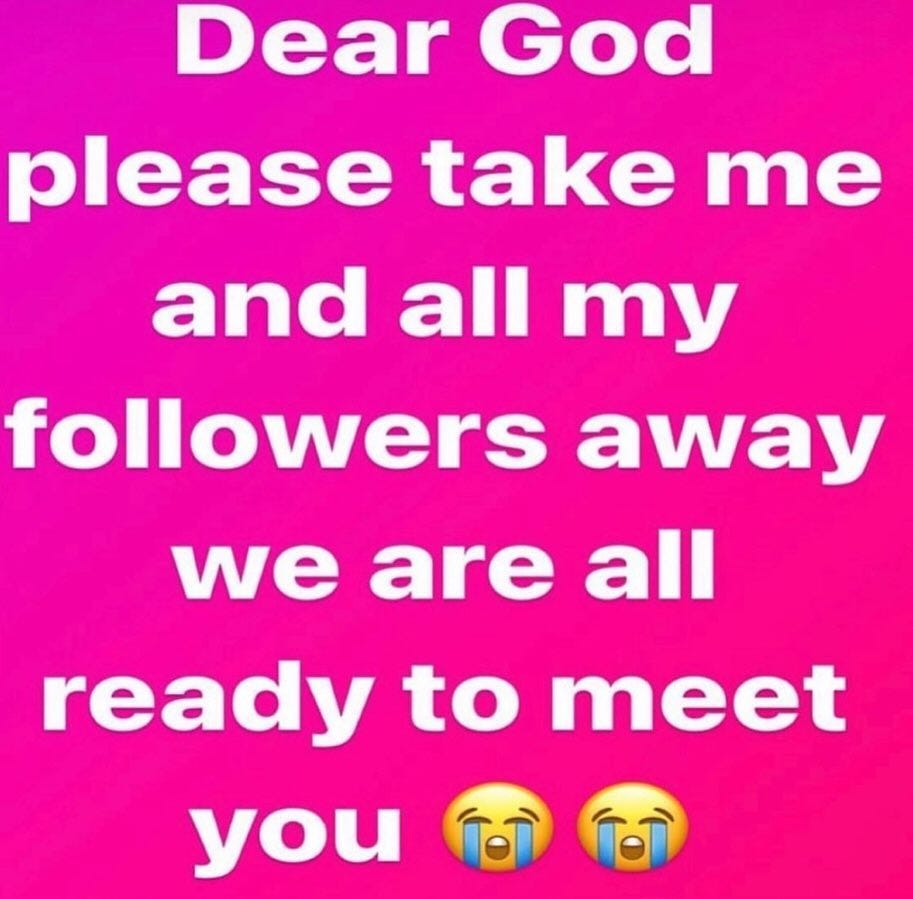
There may be something inherently kenotic — self-emptying, in the Philippians 2:7 sense — in the nature of a meme page, and its lord: in the anonymity of its offerings, it empties both the original creators and the curator of their authorial identities. It’s less like a modern art museum, where the author’s identity is clearly placarded, than a cathedral, where the architect matters less than the Creator to whom the icons and stained glass point. But unlike the authorial destabilization of AI, here there is no simulation or instrumentalization of the appropriated image for an ulterior purpose; it simply is what it is.
Even if the account hadn’t been deactivated, Hide notes the culture of social media may have already been moving in a different direction. The page’s growth had been slowing, because “the internet is different now… it’s like it’s another layer of ‘meta’ now because people already have that sense of like, complex irony/sincerity going into their creative act in the first place… Because they’re influenced by this gesture of curation and others like it, which creates this whole sort of nested series. It’s like rage bait, you know?” The page had captured the magic of a less self-conscious era of content creation, religious and otherwise — but now the very aesthetic that meme culture examined and sublimated has influenced the culture of original content, in the endless feedback loop of digital media.
Since the arrival of its current CEO Adam Mosseri, Instagram has retooled its algorithm to prioritize “original content” creators — which on the surface may sound positive; but it’s difficult to define what “original content” really means now, as predictive algorithms come more and more to form the consciousness of users, and as AI harvests its raw materials from any and all creators everywhere with impunity. And, in the context of religious content, this shift has the effect of foregrounding religious creators who often seem to be more about the cult of personality than the religious principles they represent.
Viral Christian and Catholic creators — like Anthony Gross, who visits and ranks churches, or Aubrey Corrigan, who in a recent reel models “outfits based on different denominations” (the victor is the Catholic lace mantilla), or even influencer priests like Fr. David Michael Moses — may be doing a lot to re-popularize religious devotion, and I don’t mean to cast down on their authenticity as natively digital expressions of faith. But ironically, such “original” Christian content feels less original than the supposedly “unoriginal” content of a meme page, which in its very irreverence actually makes you think and has something to say to your soul.
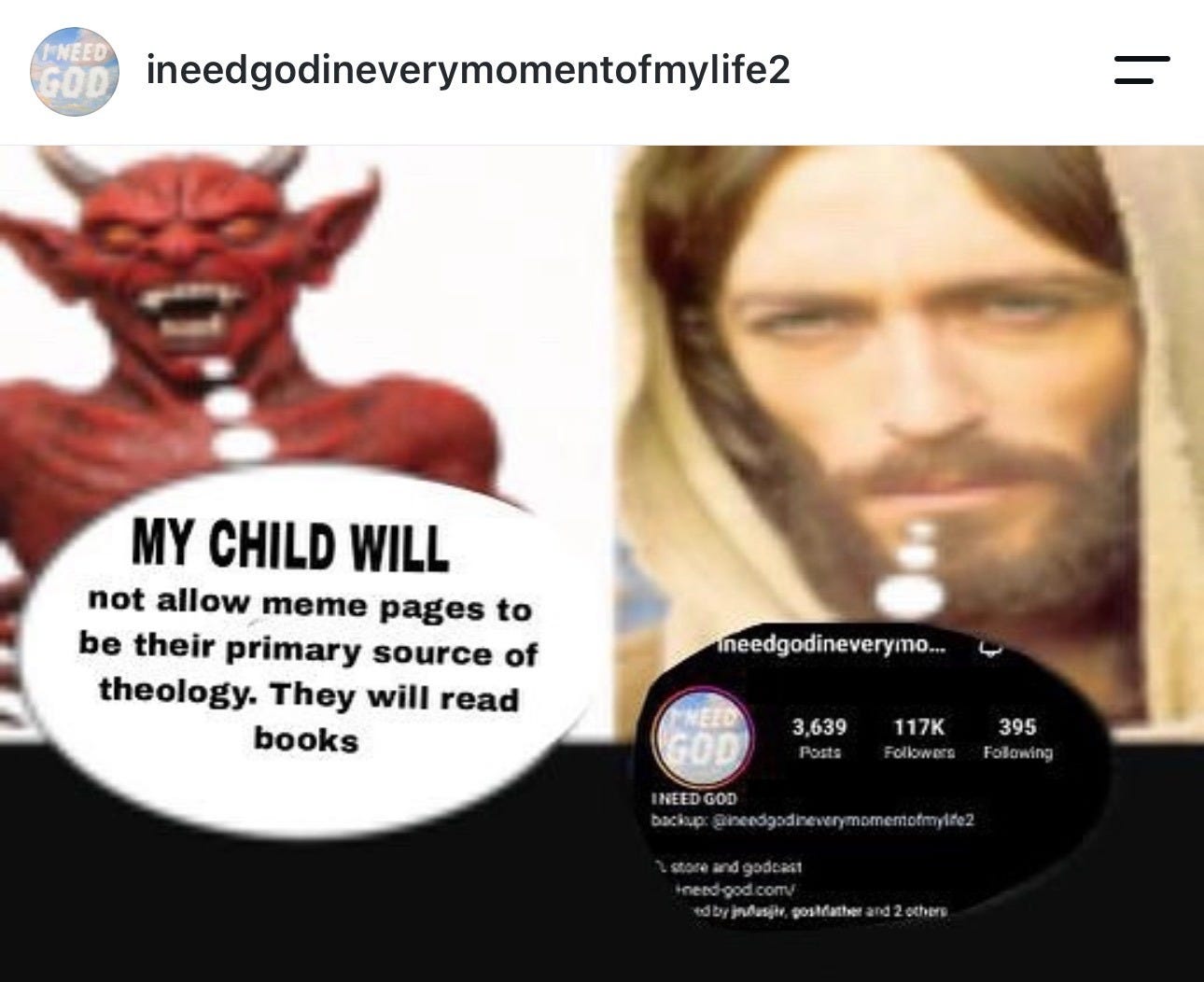
Hence, in this context of increasingly self-promotional, and at times narcissistic pop-digital religion, strange as it may sound — we need memes. Religious memeing is a critical apparatus of religious meaning: memes are theology.
The message of faith always travels through some medium — and in the infamous dictum of Marshall McLuhan, “the medium is the message” — hence the fabric of faith itself is shaped by the contours of the media that convey it; and this has important consequences for faith in an era where our main modes of communication are in one sense democratized, and in another sense corporatized and commodified.
The more religious culture becomes a digital commonplace, a constantly encountered artifact designed to conform to the algorithm, the harder it becomes for us to encounter it as sacred. This is the crux of Benjamin’s critical stance in the The Work of Art in the Age of Mechanical Reproduction — long before the era of AI slop Jesus — that the automated reproduction of artifacts causes them to lose their “aura”, their unique “presence” or authenticity.
But I think one way to understand Kyle’s work is that it reinvigorates aura, because by placing even the strangest and most “cringe” religious content in such arresting juxtapositions, it re-enlivens their mystery and strangeness, and cuts against the presentation of religious content as reproducible brand. Meme-curation as theological aura-farming.
Speaking of farming: much of Pope Leo XIV’s Magnifica Humanitas is devoted not only to A.I., but to the broader theme of “ecology of communication”. Hence creators, Christian and otherwise, have a moral responsibility to participate in digital spaces in an ecologically-minded way — not just in the sense of opposing data centers because of their water usage etc. (though that’s important), but in the sense of treating their informational offerings as part of an organic web of media relationality (for instance, in the responsible recycling of images).
My own emerging media theology — as I continue to be on the internet, but also often dislike it, and realize that God has something to do with that tension — is that spiritually “good” religious media are those that bring us back to original medium: the mysterious im-mediacy of our material being, of Presence — the re-realization, even in the midst of scrolling, that we’re actually here, whatever this is. That’s what an icon does, looking at you as much as you look at it — and, strangely, that’s what a meme can do too, when it makes you laugh, or otherwise pause.
The way out of hyperreal Christianity is not to simply “go to church” — that’s the Christian equivalent of the equally ineffectual “go touch grass” as a solution to informational excess — but to move through the complexities of our layered digital meanings on their own terms, which is what a meme page does in its act of curation. In this often toxic media ecology, we need guides and gardeners like I Need God.
But this is not a eulogy — Kyle Hide’s work continues, as is taking on new kinds of media and embodiment. Right as the page was getting banned, Kyle had just gone viral in a new form by creating a TikTok dance to Wilco’s “Jesus, Etc”. As if it were the commissioning of a new kenotic identity just as the previous one is laid to rest, “someone came up to [him] on the street and said, ‘You’re the Wilco dance guy’”.
To go from being the “ineedgod” guy to the Wilco Dance guy, to whatever other performances — is precisely the kind of liberation from personal identity and brand that can be hard for an artist to spiritually navigate in the age of digital self-representation; but Kyle seems to be doing so gracefully.
As Hide reflects: “one of the most bracing things to think about is that even if it’s not reinstated, the impact of the account is not erased.” If the trap of digital media is to align the self with the virtual, to let representation take precedence over Presence, the way out of the trap is to remember that the experiences themselves — both of the creators and their sometime followers — will always have been real.
I can say that in my own experience there’s something about I Need God in Every Moment of My Life that has always felt like when I encountered it, God was returning to my moment, rather than it estranging me from Him — and that amidst all the informational chaos that inundates us, the Holy Spirit is moving too, with a wink, with a warmth toward even what is cringe, and is present in every moment of my life.
 | A guest post by
|
this was really well-written. I don't know anything about the meme page, but you captured it so well and interrogated its meaning to you and shed light on what it means to interact with christianity via the internet. great stuff.
Ahh man, I knew this meme page, and you articulate the inarticulable good things about it so well.