

Get 50% off an annual subscription!
“We all have to be used up by something. And though I will never be a mother, I am glad to be used up by motherhood and what it leads to, just as – most of the time – I gladly belong to my wife, my children, and several head of cattle, sheep, and horses. What better way to be used up? How else to be a farmer?”
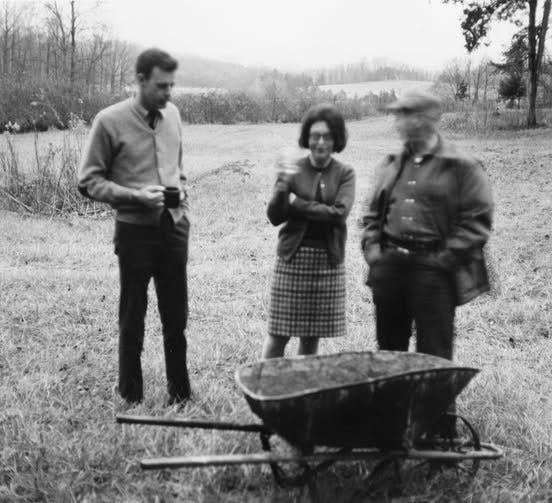
Wendell Berry, the Southern agrarian writer, farmer, and poet, died on Monday at his home in Port Royal, Kentucky, at the age of 92. He was a towering intellectual figure of bioregionalism, and an outspoken critic of technology and war. The fact that I am mourning him from 700 miles away, on a computer, in an apartment is ironic considering he left New York to write in a place where he could actually make a difference — that could not be here.
Berry’s model for a good life rests on a simple axiom: put down roots and stay there. His life and writing are characterized by the following themes, expressed most succinctly in his “Manifesto: The Mad Farmer Liberation Front,” the poem that first introduced me to the mad farmer himself: “So, friends, every day do something that won’t compute. “Love the Lord./ Love the world. Work for nothing./ Take all that you have and be poor/ Love someone who does not deserve it.” For Berry, a persistent care for what cannot demand care for itself is our duty — and that’s the art of husbandry.
Unlike his Southern Agrarians predecessors in I’ll Take My Stand, who mostly wanted the old slave plantation economy back, Berry did not call for a return. He asks for responsibility: for a life spent tending to unwieldy things — the land and the people that land makes you depend upon. This he calls the home economy, set against the national economy for which everything and everyone is an interchangeable part. His worries about the rural reflect urban realities, in “Renewing Husbandry” he wrote: “Soon the majority of the world’s people will be living in cities,” and would be “demanding the means of life from the land, to which they will no longer have a practical connection, and of which they will have little knowledge.” While much of his writing predicted the disappearance of the family farm, his real apprehension was of people like me — the New Yorker.
It is so hard to live like Wendell Berry that many of us cosmopolitan pseudo-intellectual types find contentment in the mere regurgitation of his language. We perform rootedness, obligation, and stewardship with our sourdough starters and book clubs but drop such things when they become inconvenient. These great things have practically no significance in a place like New York City. That’s roughly how I felt at the end of college here. While college might be the most self-centered time in a young person’s life, we’re hardly supposed to stay that way, and yet, rage as I may against the machine, staying in New York feels like a continuation of that self-regard. We make plans with three people in one night and cancel on two of them. Yes, community is an uphill battle sometimes, for the New Yorker, it is in fact best described as a social climb.
Besides feeling like a country bumpkin in college because I am from a Pennsylvania suburb off the mainline, I felt out of place among my peers because of my resistance to the city’s transactional logic. I would give my money to homeless people on the street only to be told by my New Yorker relatives that I was being unwise, that that is New York, and to keep your guard up. I cried about it because what about caritas, the virtue of Christian love?
In his 1987 Harper’s Magazine essay, “Why I Am Not Going to Buy a Computer,” Berry credited his wife and typist, Tanya Berry, with editing his handwritten manuscripts. A small pint in an essay about something else entirely. In a reading group in college, this small detail became the focus of the whole discussion. A friend of mine argued that model was exploitative — that Tanya was performing unpaid labor and many others agreed. The Marxists, predictably, missed the point entirely: that the mutual dependence of husband and wife was a higher good than anything a computer could produce, nor in productivity, the logic of its invention.
And this, I came to believe, was the reason no New Yorker could be a true Berryite. Berry had, in fact, addressed the feminist objections to his essay at length decades earlier, defining marriage as a state of “mutual help” and the household as an economy — neither of which a disorder to be cured by modernization. This is what he means by husbandry: “the art of keeping tied all the strands in the living network that sustains us.” The refusal to let any relation become efficient, whether that is between husband and wife or on a farm, it requires the same discipline. Berry speaks to the deliberate choice for the harder thing when faced with the logic of the computer, the logic of expediency, and for me, the logic of New York City.
I gravitate towards Berry, knowing my life looks markedly different from his. I want to be helpful in a self-emptying kind of way because, as Berry recognizes, that’s what fills you up with love. I appreciate the opportunity to make a genuine sacrifice for another, but the conditions of that act require knowledge of the other and trade-offs for the effort spent, both obstacles for the cosmopolitan whose access to (semi-) cheap expediencies that make sacrifice feel unnecessary. Why drive someone to the airport when you can call them an Uber? Why cook a meal for church when you can order and pick up large quantities of food on the way, or better yet, have it delivered? Why bring medicine to a sick friend when CVS delivers and you could instead send a text with a heart emoji? These are questions I’ve asked myself since living in the city.
New York doesn’t just make husbandry hard, it precludes it, by definition. There is no soil here to answer to, not really. There is no calf to tend to through the night. What the city sells instead is the aesthetic of rootedness, the doorman who knows your name and who, in turn, you give money to around the holidays. It is dense enough to feel like a village with none of the costs that truly define one. Call it a rootedness LARP, call it belonging to a community, but just know, those for whom you depend on might leave when their lease is up.
So, perhaps you’re wondering, why pretend to have the dirt-under-the-nails, agrarian mindset when that isn’t available here? Why pretend? Why not move? Because the LARP itself is a piece of husbandry that survives the logic of Manhattan. It is the conscious choice, and the willingness, to be used up by people who do not make your life more efficient; to get off the app; to have relationships that run on debt, on either side, neither expecting to be repaid. Staying put rejects optimization, in a sense, a kind of adherence to the Berryite philosophy.
And so, it was exactly the moment I felt myself becoming a New Yorker — no longer a temporary resident here as a college student, but a real legal resident — that I felt the urgency of Berry’s voice among the many. I’ve always been a LARPing Luddite, a faux trad, if you will — I love Alasdair MacIntyre, Paul Kingsnorth and his intellectual forebears — Lewis Mumford, Neil Postman, and Marshall McLuhan. I found no such practical manifesto nor anthology of a life aligned with those values closer to hand than in the essays and novels of Wendell Berry.
The second I feel too comfortable, too at home in New York, I feel the deeper sense of unease because I know that I’ve embraced a logic at odds with flourishing. This is the lesson of Wendell Berry and the reason I return to his words in a city so at odds with his teaching. I can’t start a farm, one tilled by horse as Berry’s was. I can’t help birth a calf. I am not going to give up my MacBook Air or autocorrect or my Instagram. I’m basically a failure — and yet, maybe that awareness counts for something.
I’m reminded by the night I spent in a hospital chair instead of sleeping before a presentation I had prepared for all day, tending to a friend, because she shouldn’t have to wake up alone. No one could stand in for me — not a text message, nor a transaction on Venmo. Freezing from the air conditioning blasting above me, no repayment could make up for the bad coffee and what five hours of fitfull naps in a plastic chair did to my back. But isn’t that the point, that it doesn’t have to?
So, my advice is simple: read Wendell Berry out loud with friends in shoebox apartments. Read his poetry on the subway. When it doesn’t feel guttural, you’re doing it wrong. If his passing is the first you’ve heard of this hero to so many — from Patrick Deneen and Rod Dreher to bell hooks and Barack Obama — then I urge you to give him a read. Start with the “Manifesto.”

Awesome. I'll start reading the Manifesto now.
I loved this, Stephen. And in your description of remaining faithful to the fragments of the life that Berry championed, even in a context that seems its antithesis, I hear an echo of Illich’s concept of "Rests", the remnants or leftovers of the vernacular to be found even in the heart of (post)modernity. I wrote about this the other day for Romanticon, pointing towards David B Schwartz's beautiful essay in The Challenges of Ivan Illich, which you might enjoy.