
Islam without submission
on zoomer leftists who reduce Islam to an identity

“I went to the West and saw Islam, but no Muslims; I returned to the East and saw Muslims, but not Islam”
-Attributed to Muhammad ‘Abduh
What would Islam look like without submission to God? On one level, the question is absurd. Islam just means ‘submission’; the entire point of the religion is to try to orient oneself to the absolutely transcendent divine, rather than to one’s own whimsical earthly desires. We might as well ask about Christianity without Christ, or Judaism without the covenant.
Yet recent trends among some millennial and Gen Z leftists force us to ask the question: could there be an “Islam” that reduces the language of God, Qur’an, and prophecy to a mere aesthetic accompaniment to a pre-chosen public political posture—an Islam in which “God” submits to what we have already decided to believe, rather than the other way round? And could that posture, in fact, contribute directly to confirming the worst suspicions of Islam’s critics while also being antithetical to the political teachings that Islamic commitments, rightly understood, imply?
The answer is “yes”—and we can find aspects of this Islam without submission in the attitudes of some of the minority-coded, anti-colonial leftists for whom Islam seems to function not so much as a revelatory tradition of reflection on the nature of God and man but as a sacred aura for anti-Western polemic.
To be clear: I, like other mortals, cannot make windows into individual men’s—or women’s—souls. I do not claim that woke leftists are not “real Muslims”. I do not assert that you cannot be a sincere mu’min—believer—in God as described in the Qur’an and also a pro-trans, pro-amnesty enthusiast for self-defeating rent controls. Few things disgust me more than the sight of my co-religionists calling each other kaffir, an identity that, concerning as it does the hidden recesses of the soul, is known only to God.
What worries me about the left-coded online discourse around admiration for—in some cases conversion to—the religion of Abraham and Muhammad is less the substance of the beliefs involved, and more the rather obnoxious vibe of the movement. Specifically, the relentless oppositionism. There is nothing wrong with admiring the resilience of Palestinians in the face of terrible suffering, for instance—nor with this admiration being a way into belief. I am sure that many people have come to a deep and sincere faith in Islam through this route.
But if all you have in your theologico-political mindset is opposition and liberation—to colonialism and exploitation; from oppression and patriarchy—you’ve missed the point of Islam entirely. Yes, Islam opposes political oppression and exploitation; yes, done right, it should bring you a liberating inner peace, too. But Islam is also, and primarily, about putting your relationship with God in good order. Fasting is not just about empathy for the hungry but about subjecting your desires to a higher good; praying at prescribed times is not a decorative, oriental bowing ritual but a means of aligning yourself with the rhythm of the sun, and the divine harmonies it reflects.
Often, the language in which this new Muslim progressivism is celebrated reveals the problem most sharply. Consider the opening salvo of this typically ghastly Guardian essay on Mamdani, for instance, in which Sarah Malik informs us that the Mayor “eats biryani with his hands, references Bollywood, is an unapologetic Muslim and a progressive”, and that this cluster of traits “proudly embodies… my own positioning as a Muslim progressive”. We have to wonder, here, what exactly biryani and Bollywood have to do with being Muslim—or progressive. And the only available answer is: Malik clearly sees all of these things as third-world coded in a vaguely Oriental and anti-Western way.
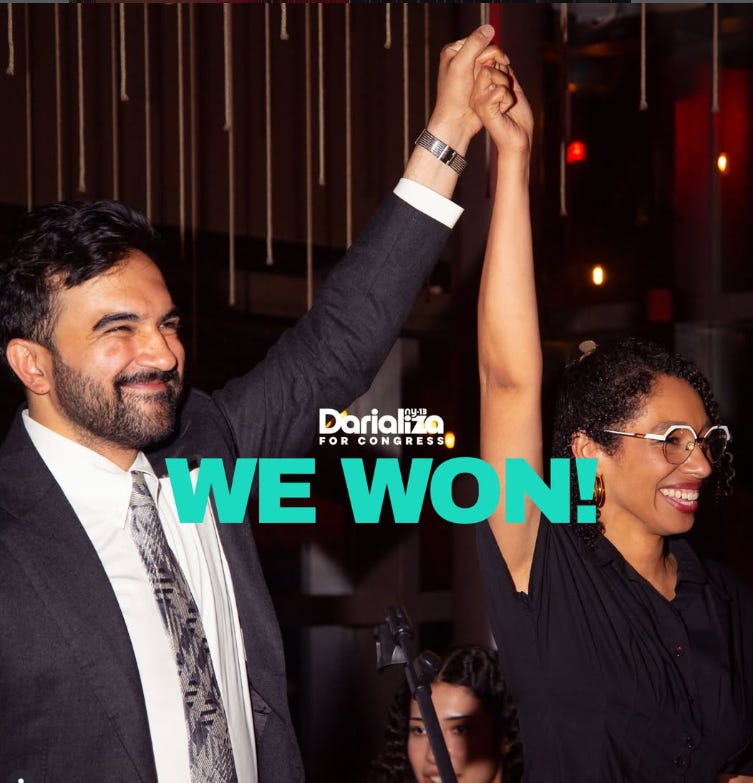
Similarly, the public semiotics of Muslim converts like Darializa Avila Chevalier positions Islam as one ingredient in a cocktail of anti-Western, left-coded components of a subaltern identity. “Congratulations sis”, says fellow leftist Muslim Ilhan Omar on Chevalier’s primary victory. Chevalier aggressively leans into her links to Mamdani and third-world heritage as “part of a generation of Dominicans who… fight for a future of solidarity and dignity”. And this solidarity and dignity apparently involves “a world without borders” and “No more police at all ever”, as she wrote in now-deleted Tweets. Islam, here, symbolically figures as an element of a subaltern rage against the Western-imperialist empire with its monstrous borders, markets, and rule of law. In its most unfiltered forms, this third-worldist vibe becomes truly unhinged, as shown by the brief TikTok fascination with a violently anti-imperialist “Letter to America” penned by a certain Osama bin Laden.
Of course you can be a sincere Muslim and hold Mamdani or Chevalier’s political views. Muslims can and do continue to disagree about how Islam’s moral commitments should translate into politics. But if the only register in which you encounter Islam is as a component of this far-left, anti-American online discourse, you risk stripping the term of its real meaning—submission and right-relation to God—in favor of an aesthetic gloss on your rage against the Western machine. Biryani bros of the world, unite. You have nothing to lose but your grievances.
All this would be bad enough if it had no ramifications beyond the spirituality of the individuals involved. Turning an act of religious submission into a performative political identity is one of the worst things a person can do for his or her immortal soul. But the salience of this discourse harms other Muslims, too, by needlessly confirming the worst fears about Islam harbored by sections of the political right. Paranoia about a “red-green” alliance between leftists and radical Islamists is widespread and toxic enough. But presenting the act of converting to Islam primarily an act of rebellion—and rebellion not against discrete injustices but against basic features of civilized life like the presence of law enforcement agents—gives the anti-Islam grifters all the fuel they need.
Again: Islam is a broad church (or rather, mosque). There’s nothing wrong with being a leftist Muslim (except insofar as being any kind of leftist is already desperately normie and passé). There’s nothing wrong with understanding your conversion, even, in part through a narrative of resistance to what you consider forms of oppression that ignore the divine spirit breathed into humanity. But when your resistance consumes your submission, when subalternity becomes your whole identity—then, you are in grave spiritual danger.
Let me close, then, by offering another conception of Islam’s role in the West, and another kind of conversion narrative—not to condemn leftist conceptions as inherently heretical, or to seek to erase their public presence, but to supplement them with a different kind of discourse. On this conception, Islam is not, principally, alterity; not primarily the antithesis to what some call Judeo-Christian civilization—but the newest component of it. And like the best kind of new arrival to a culture, it embraces its new home with all the patriotic zeal of a convert.
Previously, I wrote about what I (flirting with a semi-mythical Catholic heresy) called “Americanist Islam”. Americanist Islam, as the name suggests, enthusiastically embraces America, warts and all, as quite possibly the best place in the world to be Muslim. Seeking a “fusion” of Islamic tradition with the civil liberties upheld by the Constitution, it recognizes the extraordinary blessings of living in a country in which faith is freely chosen. Since there is, famously, “no compulsion in religion” (and no exceptions), Muslims in America and other free societies have the unprecedented opportunity of achieving a purer, freer faith than that which predominates in coercive or radically communitarian societies where faith is shaped by state power, tribal authority, or the dismal pressure to look respectable in front of your dreary neighbours. Virtue, as Christian and Jewish fusionists argued, isn’t really virtue if it isn’t chosen freely.
On a personal note, my own journey to Islam began not with a hatred for the Western tradition but with what I called a “desire to affirm as much of it as might prove compatible with religious truth”. And I found that what is best, most enduring, and most essential in the West—its respect not for libertine self-expression but for freely chosen commitment; its arts and culture; its rare genius for functioning impersonal institutions that do not subsume individuals into collective identities (no soul, the Qur’an tells us, “will bear the burden of another”)—were things I could appreciate “not despite being a Muslim, but because of it”.
This brings us back to the ‘Abduh paradox with which we began. The West has Islam without Muslims because its political order, in many important ways, embodies Islamic teachings better than that of Muslim-majority countries. Muslims without Islam, in many of these countries, labor under oppressive regimes that disrespect and destroy genuine, freely chosen faith. And biryani-coded revolutionary subalternity risks yielding something even worse: “Islam” without submission, politics without prudence, and grievance without God.
 | A guest post by
|
Some interesting ideas but a shitty article as a whole. You don’t define ”left”.
FYI - left is about wealth redistributiion, affordable life for all, fair distribtuiion of ownership of the means of production.
The identity (woke) people you seem to fight against are neoliberals = hardcore right. They use identity-issues to obfuscate from class-discussions.
Why are you gay?