

If there is one aspect of Millennial culture I hope that our generational successors jettison, it is the concept of “introverting.” Along with profane tea towels and self-help books, Harry Potter, and Cards Against Humanity, it belongs on the ash heap of history.
Psychology Today explains that an introvert is someone who prefers “the inner life of the mind over the outer world of other people.” “Introverting,” then, is a neologism usually deployed to mean an unapologetic retreat from public or social life. I’m an introvert myself; I tend to prefer time alone to read, exercise, watch a movie, or do housework. But I don’t like the adoption of “introvert” as an identity that requires societal carveouts.
I’ll explain what I mean. “Introvert” is a personality type. It isn’t good or bad, it’s just that you get your energy from being alone or in small groups, rather than from large groups. It isn’t a diagnosis. And yet people who self-identify as introverts sometimes seem to feel like their introversion gives them social license to be misanthropic.
Take this Instagram slideshow I found. It is entitled, “15 Images every introvert relates to.” The first image is an unkempt cartoon person scowling, wrapped in a blanket with the phrase “current mood” written overhead (why?). Later, a waving cartoon puppy: “I suck at keeping in touch, but I like you,” the caption reads (that’s just inconsiderate?). Still later, a pie chart entitled “Why I am on Instagram,” where the two categories are “To make friends and socialize,” and “To see memes.” Guess which one is a tiny sliver (who is so introverted that they can’t even be sociable online?).
Then there’s another reel explaining introvert life.” “We’re introverts, we want to be invited to the party, even though we probably won’t go,” a woman says with a chipper smile. “We’re introverts. The thought of making small talk makes our armpits sweat, so we’re probably going to ask you really deep, intrusive, inappropriate questions to get to know you better.” It’s funny, and I’ll acknowledge that I find the underlying sentiment relatable.
But whatever this is, I’m not sure that’s actually introversion. Maybe some kind of social anxiety? A touch of autism? Seasonal depression? Anyway, even if the above phenomena were universally true to the introvert experience, in this type of for-us-by-us content, there’s very little sense that anything about it might be wrong in some way. People should just understand.
And look, introvert here! I get that it’s often exhausting to do things with other people and it is nice to be left alone sometimes. But I’d also argue that it’s necessary to repress our introvert tendencies more than we give into them, in order to be a contributing member of our communities.
Making “introvert” a key personal identity marker carries an underlying threat. Often, it is accompanied by an evident sense of superiority to the kind of sheeple who go to large parties or make small talk.
It’s what I call “Liz Lemon Syndrome.” In an episode of the TV show 30 Rock, TV sketch comedy writer Liz Lemon (played by Tina Fey) remembers her high school experience as a bullied nerd. But at her high school reunion, we learn that she was a quirky loner, yes, but she was actually fairly cutting and judgmental toward the popular kids.
I suspect these kinds of nerdy introverts populate a lot of TV and movie writers’ rooms. At least since I was a kid, popular media tends to portray the kids who roll their eyes at the popular kids, who don’t go to parties, who are allergic to superficiality, as actually the most special, the sensitive misunderstood intellectuals. “Be yourself! Don’t follow the crowd!” is a popular message in kids’ entertainment. That’s fine advice if the crowd in question is pressuring you into risky sexual behavior at a young age or going all-in on National Socialism. But groups of people in public aren’t bad in and of themselves, and you aren’t actually the secret Princess of Genovia just because you don’t care for them.
Anyway, I certainly absorbed this message. In my imagining growing up, I was Belle in the opening number of Beauty and the Beast, “never part of any crowd/’Cause her head’s up on some cloud,” meant for better things than the provincial life of my myopic extroverted classmates. But in reality, most of the time, if you stand off to the side critically evaluating or frequently opting out of things that everyone likes–including something as basic as being together in a group–you’re kind of the problem. It took me until I was in my late thirties to realize that aversion to small talk actually isn’t a virtue. In fact, surface-level pleasantries are an important part of getting to know people and your community.
Although I’m not really a joiner, I make myself do a lot of things with groups and organizations. It’s not a natural fit for me, to be honest. And I do find it really draining sometimes at the end of a long day. But the benefit is belonging to a community and being a part of something bigger than myself. As human beings, this ultimately is what we’re made for.
If you want society to recognize your introversion as a trait that requires special consideration, the flip side of that is understanding that justice is giving others what is due to them. We owe those around us the best of ourselves. And if we’re being honest, our best self is not always the same thing as our authentic self.
I’ve learned a lot from John Machnee, the host of the Christianity on the Spectrum podcast. He is frequently on X adjuring his fellow ASD1 folks to learn to “mask” (essentially to fake neurotypical behavior), at least just a little bit, if they want to make friends or date.
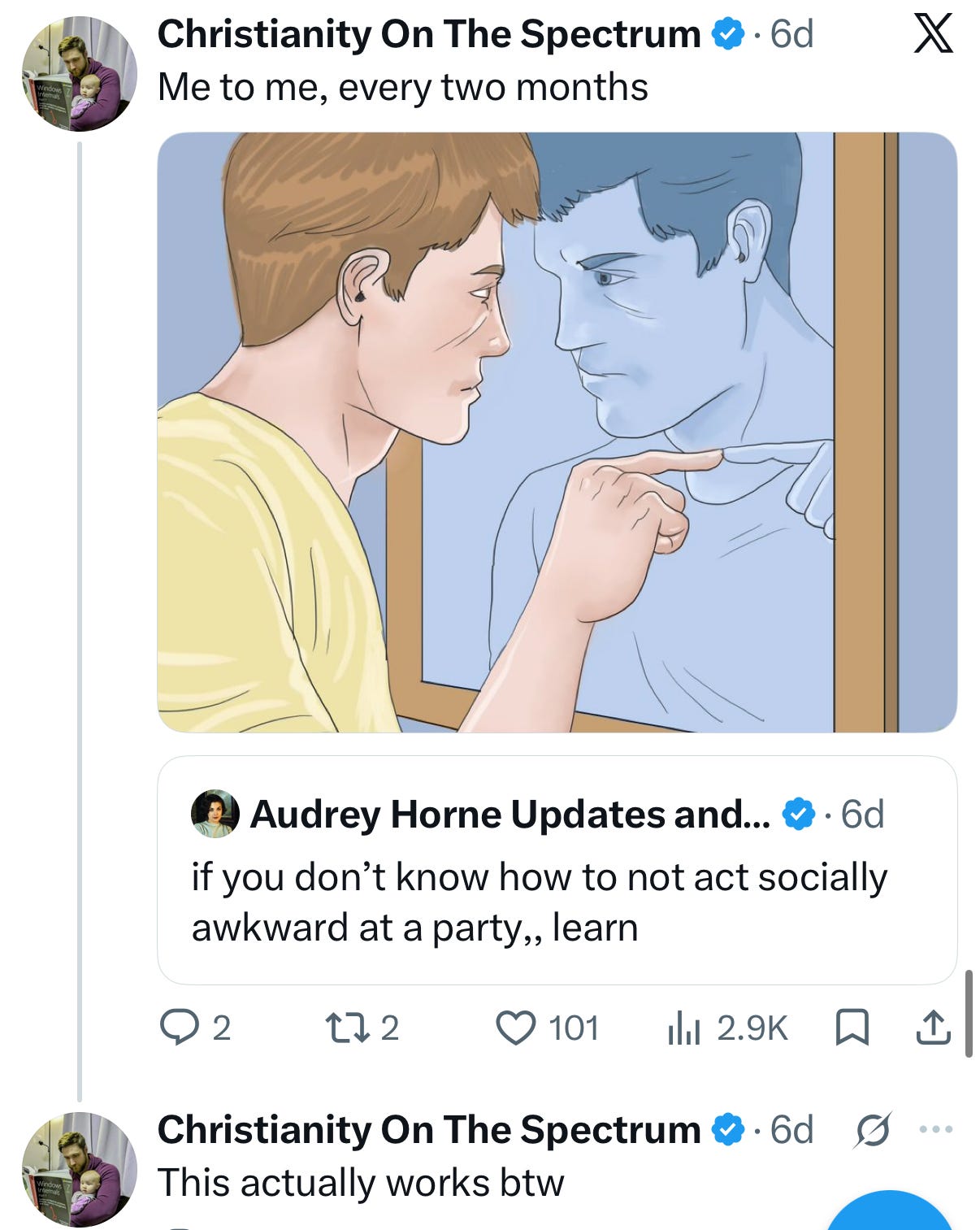
Making introversion a key component of your personality risks a kind of entitled safetyism. Where is it written that we should never be tired or uncomfortable if we can help it? Who owes us that? Reality has a bias, and it favors extroverts. And thank God for that, because that’s the whole reason we were able to develop market economies and governments and culture. What do you gain by opting out? A few more hours alone?
Take an invitation to a house party for instance. Someone who has undertaken the logistical, emotional, and financial burden to host a gathering is owed the courtesy of the introvert’s time and attention. Showing up tells that person that you value them: you made the effort, you put in the time. If you as the introvert are a little more tired than usual on the other end, that’s simply the price you pay to be a part of something human.
Frankly, not liking to go out doesn’t make you special. Moreover, staying home or standing on the margins when you could otherwise put yourself out there isn’t justice. But you can strike a balance. A therapist once explained to me the value of “putting in an appearance.” Essentially, she explained to me that habitually declining (or worse, ignoring) invitations is actually really rude. But if you’re an introvert, you’re also not obligated to stay the entire time or to be the life of the party. Show up, drop off a bottle of wine, make yourself known to the host and exchange a few pleasantries with other guests, and you’re home in your socks watching Widows Bay again before you know it.
To quote George Costanza, “We’re living in a society.” I’d encourage my fellow introverts to act accordingly. The urge to protect the authentic introverted self from feeling emotionally depleted is as deleterious to the introvert as it is to their community. So fake it till you make it. Accept the next invitation whether you want to go or not. Don’t flake. Show up and join in some small talk (without judgment). Then, go home at the earliest possible opportunity, and go to sleep.

Small talk may be shallow in content without being shallow in function. “How are you?” or a few words about the weather exchange very little important information, but the interaction carries another message: I see you, I’m willing to respond to you, and the relationship between us still exists.
That may explain why repeatedly declining invitations can cost more than a few missed parties. Relationships have to be repeatedly confirmed through interaction, and once a relationship exists, information, help, opportunities, resources, and cooperation can move along that connection. For an introvert, showing up, making an appearance, and exchanging a few pleasantries may be less about pretending to be extroverted than about paying the cost of maintaining a relationship.
I've learned what limits I need as an introvert. I can handle small groups much better than large crowds and, really, who is going to miss me at a gathering of 100+ people? It's the small groups where I meet with friends and family to have those vital interactions. Is it draining? Yes, especially with my level of hearing loss, but it is well worth the effort.
On the flip side, I've yet to hear an extrovert claim they need to move out of their comfort zone. Maybe you don't have to be the one who speaks first and often, dominating the conversation, or who tries to force friendships between strangers through awkward ice breakers. Just zip it and let people make small talk on their own. It would be easier on introverts who do venture into public if some people didn't think they needed fixing.